


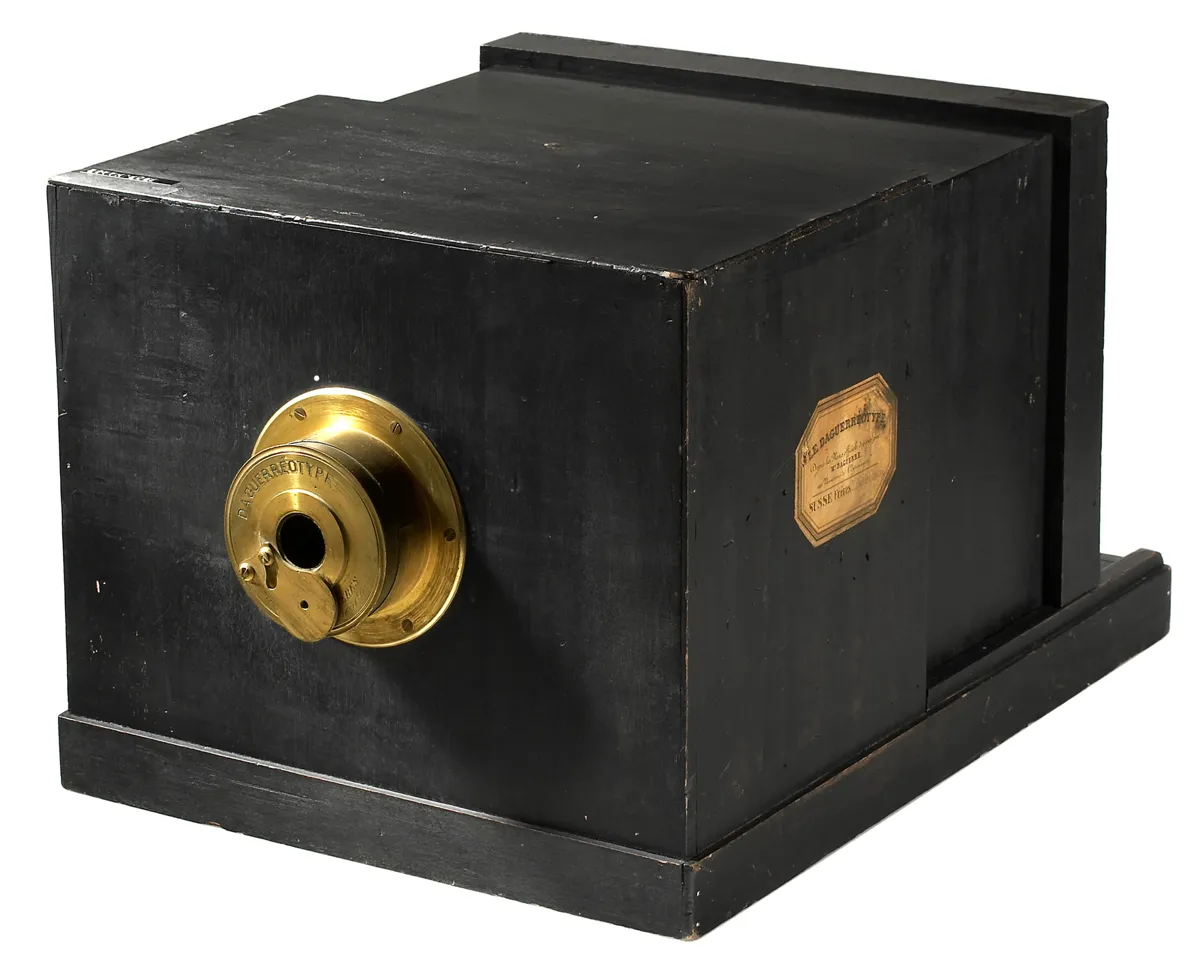
On 7 November 1839, at seven in the morning, in front of the gates of the Ras el-Tin palace in Alexandria, two Frenchmen set up a heavy box of wood and brass before a fortified gate. A few steps away, reclining on his divan, Méhémet Ali, viceroy of Egypt, watches the scene with curiosity mixed with wariness. Barely eleven weeks earlier, thousands of kilometres away, another man had unveiled in Paris the process that would, that very morning, touch African soil for the first time.
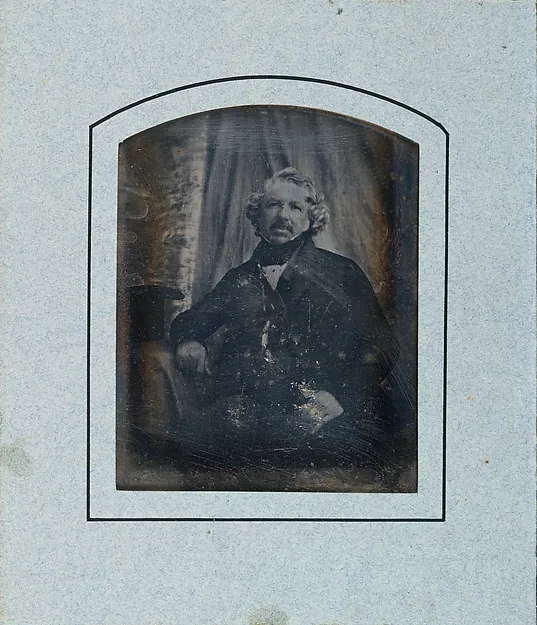
A few months back. On 19 August 1839, in a crowded hall at the Institut de France, the astronomer and physicist François Arago officially unveiled the daguerreotype process on behalf of Louis-Jacques-Mandé Daguerre, before the assembled Académie des sciences and Académie des beaux-arts. The news spread like wildfire: "a few days later, black three-legged boxes could be seen planted in every square in Paris, in front of churches and palaces," reported a German witness present that day.1Jeff Koehler, "Capturing the Light of the Nile, Egypt's First Photographs," AramcoWorld , vol. 66, no. 6 (November-December 2015). The French government, which had bought Daguerre's patent on 1 August 1839 to give it "nobly to the whole world," hoped from the outset for a scientific use of the process: to document, at last "objectively," the remains of Antiquity.

Diagram of the process — the four operations Vernet, Goupil-Fesquet, Joly de Lotbinière, Girault de Prangey and Itier had to carry out, often under the difficult climate of the Nile or the Senegalese coast, with fragile chemical equipment hauled across thousands of kilometres. Original infographic made for this article.
Arago himself had singled out Egypt as the natural proving ground for the new technique, publicly regretting that daguerreotypy had not existed at the time of Bonaparte's expedition: "Everyone will grasp the extraordinary advantages that could have been drawn, during the Egyptian expedition, from a means of reproduction so exact and so rapid," he told the Académie.1Jeff Koehler, "Capturing the Light of the Nile, Egypt's First Photographs," AramcoWorld , vol. 66, no. 6 (November-December 2015). The publication, between 1809 and 1829, of the twenty-four volumes of the Description de l'Égypte — drawn from the work of the scholars who had accompanied Bonaparte, draughtsmen and engravers rather than photographers, since the process did not yet exist — had already fed a lasting French fascination with the Nile valley, its temples and its hieroglyphs, recently deciphered by Champollion. It is therefore no surprise that African soil received the light of the daguerreotype before almost any other continent outside Europe: scientific demand and public taste had preceded the technique by decades.
Lerebours's commission and the departure for Alexandria
The Parisian optician Noël-Marie Paymal Lerebours, eager to assemble the first great photographic collection of the world's monuments — an undertaking at once scientific and commercial, meant to feed an engraving market then in full expansion — equipped several amateur travellers with cameras and chemicals. He entrusted a mission to the orientalist painter Horace Vernet, then director of the Académie de France in Rome, and to his nephew Frédéric Goupil-Fesquet (1817-1878), tasked with producing views to complement his uncle's sketches.1Jeff Koehler, "Capturing the Light of the Nile, Egypt's First Photographs," AramcoWorld , vol. 66, no. 6 (November-December 2015).2Frédéric Goupil-Fesquet, Voyage d'Horace Vernet en Orient , Paris, Challamel, 1843. The two men left Marseille on 21 October 1839 — barely two months after Arago's presentation — stopping in Italy, Malta, and Greece before landing in Alexandria on 4 November 1839.
On 6 November, the French consul introduced them to Méhémet Ali, viceroy of Egypt, reclining "on his divan, in a corner of the salon," as Goupil-Fesquet would recount in his Voyage d'Horace Vernet en Orient, published in Paris in 1843. The ruler, curious about the progress of the arts and sciences in Europe — he had already brought in engineers, doctors and military instructors from Europe to modernise his administration — expressed a wish to see the new instrument at work. A meeting was arranged for the following morning, at the Ras el-Tin palace on the harbour of Alexandria.
7 November 1839: the first documented photograph of the African continent
It was on 7 November 1839, at seven in the morning, in front of the gates of the Ras el-Tin palace, that Vernet and Goupil-Fesquet made the view that several historians of photography now consider the first documented photograph of Egypt — and, more broadly, of the African continent.1Jeff Koehler, "Capturing the Light of the Nile, Egypt's First Photographs," AramcoWorld , vol. 66, no. 6 (November-December 2015). The original plate is now lost; the image survives only as an engraving made after it, showing a fortified gate with two men standing before it, a guard and a doorkeeper, with the palace harem and its low roofs in the background.
The scene of the shoot itself was preserved in memory thanks to Goupil-Fesquet's account. The operation — sensitising the plate with iodine vapour, exposure, development with mercury vapour, then fixing with sodium hyposulfite — took several minutes under Méhémet Ali's wary gaze.
An Egyptian fever: Khufu, Joly de Lotbinière, and the publication of the views
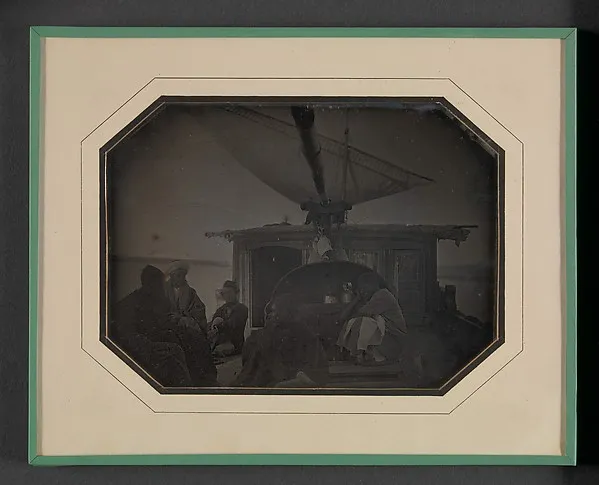
The two Frenchmen did not stop there. On 20 November 1839, Goupil-Fesquet captured the pyramid of Khufu at Giza after a fifteen-minute exposure — "we are daguerreotyping like lions," Vernet wrote to a correspondent at the time.1Jeff Koehler, "Capturing the Light of the Nile, Egypt's First Photographs," AramcoWorld , vol. 66, no. 6 (November-December 2015). In Alexandria, they crossed paths with a third daguerreotypist, the Swiss-Canadian Pierre-Gustave Joly de Lotbinière, also commissioned by Lerebours, who had just made, in Athens in mid-October 1839, the very first photographic views of the Acropolis before moving on to Egypt. He would continue alone southward, photographing Karnak, the Colossi of Memnon, Philae, and Abu Simbel, for a claimed total of ninety-two views — a journey up the Nile that, in a matter of weeks, covered nearly a thousand kilometres of Egyptian valley, from Lower to Upper Egypt.
None of this pioneering trio's original plates survived: we know them only through the engravings published between 1840 and 1844 in Lerebours's Excursions daguerriennes: vues et monuments les plus remarquables du globe, and in Hector Horeau's Panorama d'Égypte et de Nubie (1841) for Joly de Lotbinière's views. Three years later, Girault de Prangey would retrace almost the same route south, with better equipment; it is his plates, this time, that survived the centuries.


Girault de Prangey (1842-1845): the largest photographic undertaking of its time
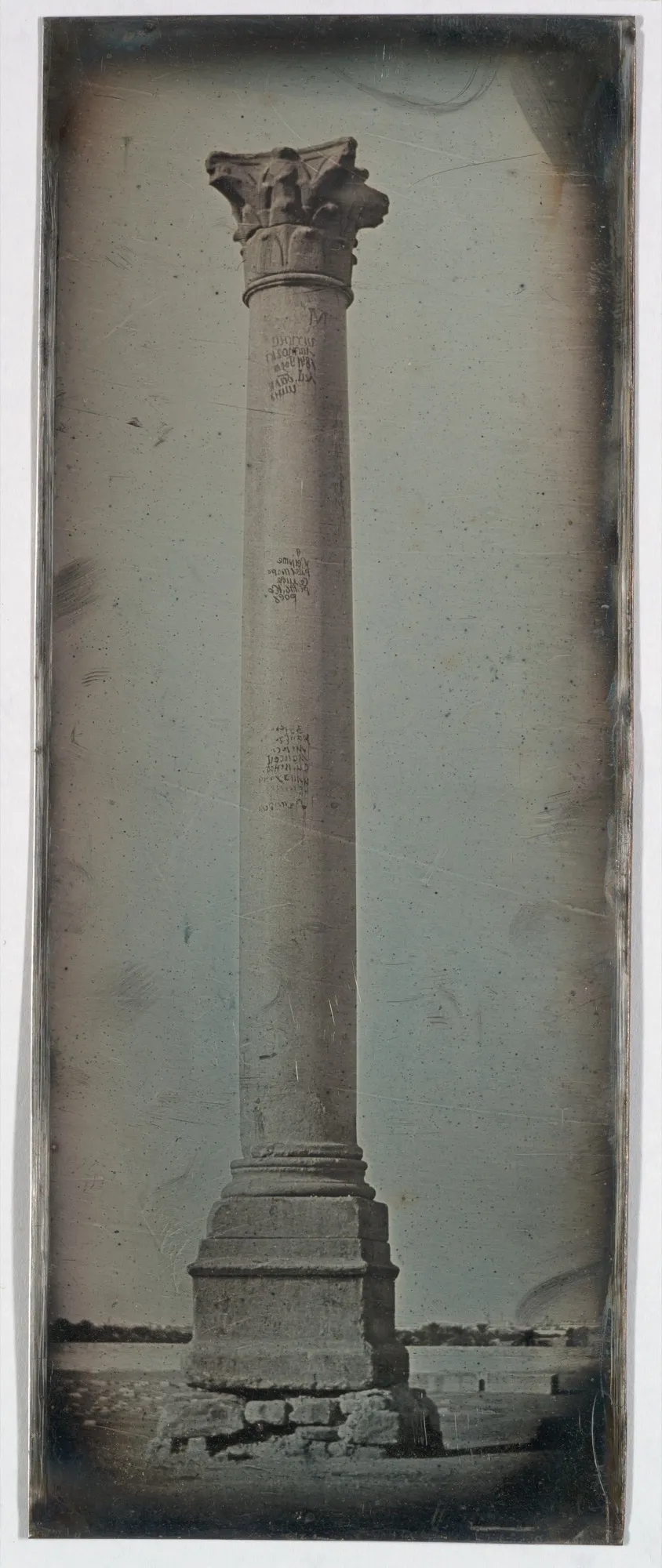
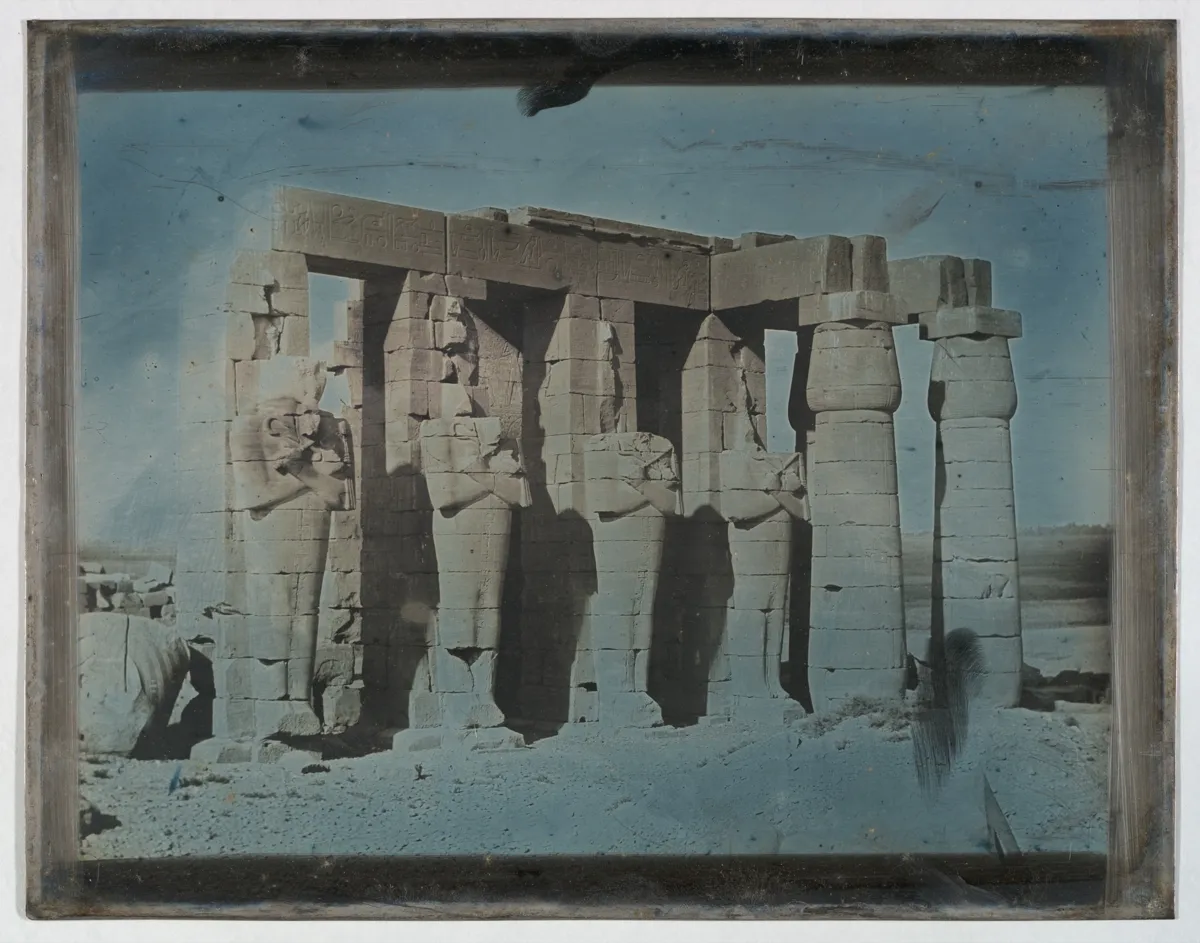
Three years later, the architect and daguerreotypist Joseph-Philibert Girault de Prangey (1804-1892) set out, from 1842, on a three-year journey across the eastern Mediterranean — Greece, Egypt, Turkey, Syria, Lebanon — carrying his daguerreotype equipment, including the now-famous limewood plate case held today at the Met. Arriving in Egypt in the autumn of 1842, he explored Alexandria and Rosetta before settling in Cairo, where he spent several months photographing Islamic and pharaonic architecture — minarets, domes, monumental gates, hypogea — before travelling up the Nile as far as Philae and Edfu in 1844. In total, Girault de Prangey brought back more than a thousand daguerreotypes, a body of work without equal for its time.3The Metropolitan Museum of Art, "Monumental Journey: The Daguerreotypes of Girault de Prangey," press and exhibition materials, New York, The Met, 2019.


Unlike the plates of Vernet, Goupil-Fesquet, and Joly de Lotbinière, a significant portion of Girault de Prangey's daguerreotypes survived: they are today the oldest surviving photographs — not merely known through engravings — of Egypt and the Near East. Left largely forgotten on the family estate in Langres after the photographer's death, they did not resurface until the twentieth century and were only fully revealed to the public quite recently, through conservation work and museum exhibitions.3The Metropolitan Museum of Art, "Monumental Journey: The Daguerreotypes of Girault de Prangey," press and exhibition materials, New York, The Met, 2019. Girault de Prangey also made, during this journey, some of the very first photographic portraits taken in Africa — a genre that daguerreotypy, because of its very long exposure times, had until then almost exclusively reserved for motionless monuments.
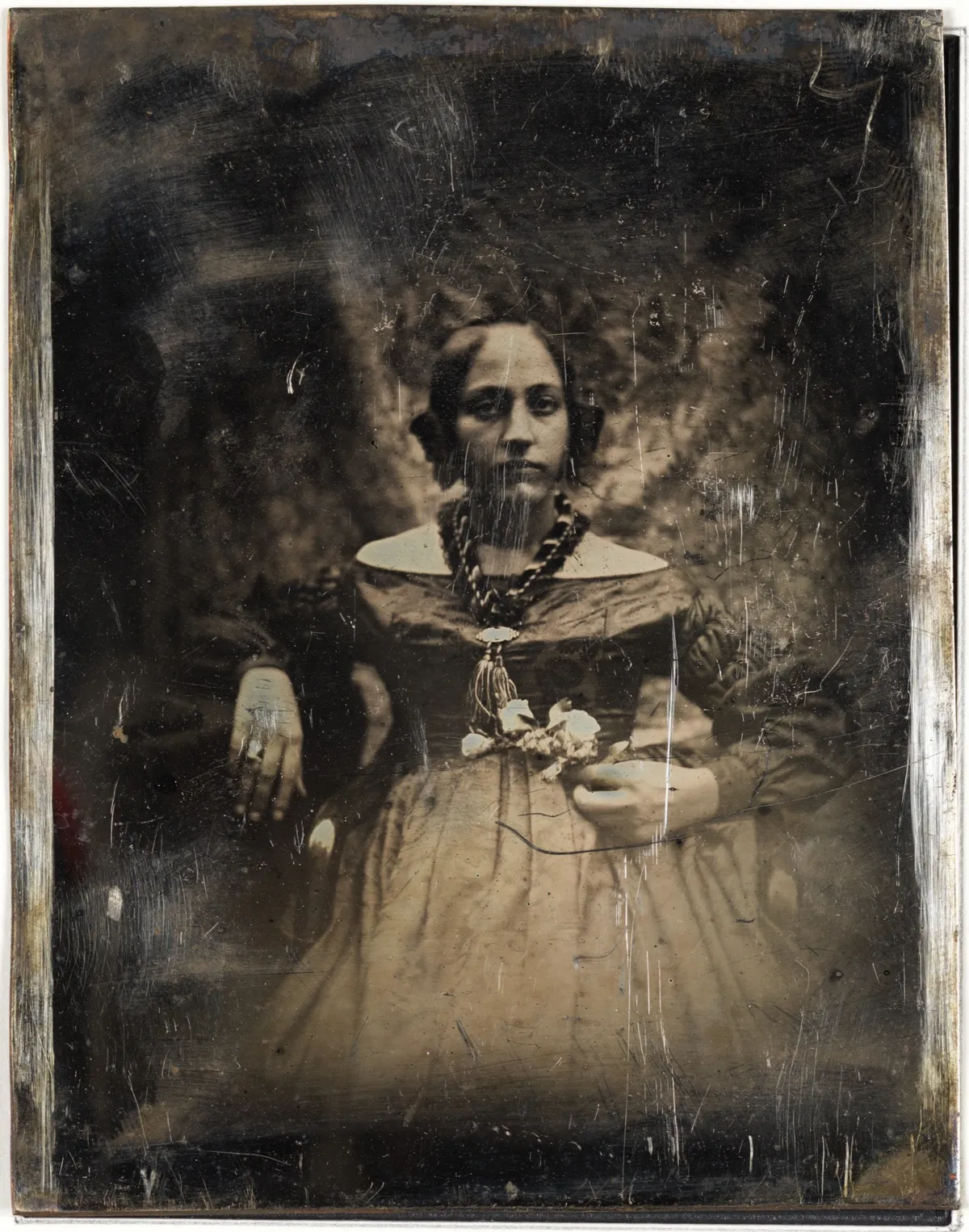
South and west: Senegal, Liberia, and southern Africa
Long before the daguerreotype reached southern Africa, it had already taken hold much further west. As early as 1842, the French customs official and traveller Jules Itier carried a daguerreotype camera on a trade mission that took him, via Gorée, to Saint-Louis-du-Sénégal; the plate he made there — the earliest documented photograph of West Africa — dates from the very start of 1843.4Giulia Paoletti, Portrait and Place: Photography in Senegal, 1840-1960 , Princeton, Princeton University Press, 2024. Itier would go on with his mission as far as China, where in 1844 he made one of the very first daguerreotypes taken on Chinese soil, before returning to photograph Egypt and the Near East. His passage through Senegal makes him, not the daguerreotypists of the Cape, the first documented photographer to have worked in sub-Saharan Africa — a milestone that a chronology centred on southern Africa tends to obscure.
A decade later, a figure of a wholly different kind enters this history: Augustus Washington (c. 1820-1875), an African-American daguerreotypist trained in Hartford, Connecticut, who emigrated in 1853 to Liberia — a republic founded by formerly enslaved people under the auspices of the American Colonization Society — and opened a studio in Monrovia. There, until around 1858, Washington photographed the Black American settlers who had themselves become landowners and political leaders of the young republic — including President Stephen Allen Benson and several Liberian senators — before turning to a career of his own as a judge, then as Speaker of the Liberian House of Representatives.5Annie Elizabeth Poslusny, The Liberian Daguerreotypes of Augustus Washington: Photography, Science, and Blackness as Selfhood , doctoral dissertation, University of North Carolina at Chapel Hill, 2021. Neither a passing European traveller nor an indigenous photographer in the sense Schneider or Haney would later give the term, Washington occupies an intermediate and singular position in this history of African photography: that of a settler of African descent photographing, from the inside, the society he was himself helping to build — and whose colonial logic toward Liberia's indigenous populations he would, in time, come to perceive and denounce.
Further south and east, along the Indian Ocean coast and in the British Cape Colony, daguerreotypy took considerably longer to put down lasting roots. According to historian Patricia Hayes (University of the Western Cape), the process "travelled quickly across this liquid frontier" formed by colonial shipping routes, reaching Durban via Mauritius in September 1846.6Patricia Hayes, "Power, Secrecy, Proximity: A Short History of South African Photography," Kronos , vol. 33, no. 1, 2007, pp. 139-162 (SciELO South Africa).7M. Bull and J. Denfield, Secure the Shadow: The Story of Cape Photography from Its Beginnings to the End of 1870 , Cape Town, Terence McNally, 1970 — cited in Hayes, 2007. Unlike Talbot's English calotype, the French patent was protected by no monopoly, so it spread unhindered after 1839 across the French-speaking colonies and their commercial spheres of influence.
It was the Frenchman Jules Léger who landed, aboard the schooner Hannah Codner, at Algoa Bay (present-day Port Elizabeth), where by October 1846 he was exhibiting a series of portraits of settlers and local views, described by the Grahamstown Journal of November 1846 as "magnificent, wonderful, interesting."6Patricia Hayes, "Power, Secrecy, Proximity: A Short History of South African Photography," Kronos , vol. 33, no. 1, 2007, pp. 139-162 (SciELO South Africa). His associate William Ring then carried the equipment on to Cape Town, with less success. It was not until 1851 that three daguerreotypists — Carel Sparmann, William Waller, and John Paul — set up lastingly profitable studios there.6Patricia Hayes, "Power, Secrecy, Proximity: A Short History of South African Photography," Kronos , vol. 33, no. 1, 2007, pp. 139-162 (SciELO South Africa).7M. Bull and J. Denfield, Secure the Shadow: The Story of Cape Photography from Its Beginnings to the End of 1870 , Cape Town, Terence McNally, 1970 — cited in Hayes, 2007. Hayes notes that "there is no evidence of photographs taken before 1845" at the Cape, the technology having taken several years to cross the sea distance separating Europe from the southern tip of the continent.
An uneven geography of sources — the earliest and best-documented point, Alexandria in November 1839, belongs to the part of the continent most intensively photographed by European travellers in the 1840s. Senegal, Liberia, southern Africa, and Algeria, by contrast, only enter the record one to seven years later, and often with not a single openly accessible plate surviving today. Original infographic made for this article.
The case of French North Africa: a patchier record
The story of the daguerreotype's arrival in Algeria, a French colony since 1830, is far less well established than that of Egypt or the Cape. Historians of colonial photography, foremost among them David Prochaska (University of Illinois), have shown that photography did not become a systematic instrument of documentation there — administrative, military, ethnographic, touristic — until the second half of the nineteenth century, the output of the 1840s remaining fragmentary and scattered across private collections and still poorly catalogued archives.8David Prochaska, Making Algeria French: Colonialism in Bône, 1870-1920 , Cambridge, Cambridge University Press, 1990. This documentary asymmetry alone illustrates how hard it is to write a continuous history of photography in Africa in the nineteenth century — and foreshadows the larger problem addressed further below.
"The first photograph of Africa": the wrong question?
Should we, then, stop at this date of 7 November 1839, and at this palace in Alexandria photographed by two passing Frenchmen? Historians specializing in African photography urge caution. In their foundational article, David Killingray and Andrew Roberts note that most of the continent's photographic output in the early decades remained the work of European travellers, missionaries, and administrators, and that the sources available for this period "remain extremely uneven from one region to another."9David Killingray and Andrew Roberts, "An Outline History of Photography in Africa to ca. 1940," History in Africa , vol. 16, 1989, pp. 197-208.
Erin Haney, in Photography and Africa (2010), goes further: she explicitly rejects the project of a linear, exhaustive history of African photography, insisting on the need to situate each image within its socio-political conditions of production10Erin Haney, Photography and Africa , London, Reaktion Books, "Exposures" series, 2010. — a warning that applies with even more force to the very notion of a "first photo," which presupposes an outside gaze, that of the Western traveller who came to document monuments deemed worthy of interest by criteria of his own. Jürg Schneider shows, conversely, that genuinely African photography — that is, made by African photographers, for local clienteles — only emerges in the second half of the nineteenth century, with figures such as Francis W. Joaque, active in Sierra Leone, Fernando Po, and then Gabon from the 1860s onward.11Jürg Schneider, "The Topography of the Early History of African Photography," History of Photography , vol. 34, no. 2, 2010, pp. 134-146.
There are, in reality, two distinct histories that too often get collapsed under the convenient label "the early days of photography in Africa": one, well documented, of the daguerreotype's arrival by the colonial and touristic route — of which the Ras el-Tin palace view of 7 November 1839 constitutes, on present evidence, the earliest and best-attested milestone — and another, later and harder to reconstruct, of the medium's appropriation by African societies themselves.
Conclusion
In the end, while the search for the first image invariably leads us back to 7 November 1839, at the Ras el-Tin palace, that date tells only part of the story — the European, touristic part, an outside gaze cast upon Egypt. The photograph made that morning by Horace Vernet and Frédéric Goupil-Fesquet remains, as matters currently stand, the first documented image of the African continent — a vanished document, known only through an engraving, taken barely eleven weeks after the process was publicly unveiled in Paris. It opened a decade of orientalist daguerreotypy in Egypt, carried forward by Joly de Lotbinière and then, on a far larger scale, by Girault de Prangey, while the process reached West Africa as early as 1842 with Jules Itier in Senegal, then, at the slower pace of colonial shipping routes, southern Africa from 1846 and Liberia in 1853 with Augustus Washington. But this chronology, precise as it is, should not obscure a more complex reality: that of a medium taking several decades to become truly African, in the sense of Africans — from Francis W. Joaque to those who followed him — taking it up themselves as practitioners, and not merely as subjects.
Documentary challenges: a North-South archival divide
One fact deserves to be stated plainly: of the thirteen photographs in this article, ten come from Egypt, and only one — Itier's cange — touches, indirectly, on West Africa. Not a single plate from Saint-Louis-du-Sénégal, Monrovia, or the Cape appears here. This imbalance is not an editorial choice: it is the exact, documented reflection of a patrimonial asymmetry that still structures the visual history of the continent today.
Girault de Prangey's Egyptian daguerreotypes survived because they remained, through family inheritance, on French soil, before entering the collections of a richly endowed museum — the Metropolitan Museum of Art — which digitised the entire holding in high resolution and placed it under an open licence (Open Access) in 2019-2020. Augustus Washington's Liberian daguerreotypes, by contrast, are partly held at the Smithsonian's National Portrait Gallery in Washington: an equally serious American public institution, but one whose rights policy does not, to date, permit equivalent free reuse. As for Jules Itier's plates from Senegal, or the very first portraits taken at the Cape, their precise location and state of preservation remain, for the general public as for this article, largely unverifiable online. The problem, then, is not only an absence of images: it is an absence of access, one that maps almost exactly onto the old colonial empires and their museums.
This divide, however, is not fixed. The British Library's Endangered Archives Programme, launched in 2004 with support from the Arcadia foundation, has spent twenty years funding the digitisation of threatened archives around the world, including several West African and East African photographic collections — a direct institutional response to the problem described above.12The British Library, Endangered Archives Programme — archive digitisation programme, Arcadia foundation, launched in 2004. eap.bl.uk The work of historians such as Giulia Paoletti on Senegal, Jürg Schneider on Central and West Africa, and Patricia Hayes on South Africa draws precisely on this kind of rediscovered holding, often preserved within families, religious missions, or local administrations rather than in major Western museums.
Finally, this history needs situating within its contemporary continuation, so that it does not stand only as a catalogue of nineteenth-century curiosities. Since the 1990s, African institutions have been actively reclaiming the narrative and the practice of the image: the Rencontres de Bamako, Africa's biennial of photography, founded in Mali in 1994, remains the continent's largest gathering in the field; the Market Photo Workshop, founded in Johannesburg in 1989 by photographer David Goldblatt to train Black South African photographers under apartheid, has trained several generations of now internationally recognised artists; the LagosPhoto festival, launched in Lagos in 2010, does the same for anglophone West Africa. These institutions do not close the patrimonial divide described above — the nineteenth-century archives remain, materially, where they are — but they durably shift the question of "who looks at whom" that Méhémet Ali, without knowing it, was already posing in front of Vernet's darkened chamber, that morning in November 1839.
A note on method: text drawing exclusively on academic sources, peer-reviewed journals (History in Africa, History of Photography, Kronos), and museum exhibition materials, to the exclusion of any collaborative online encyclopedia; the African institutions cited toward the end of the article (Rencontres de Bamako, Market Photo Workshop, LagosPhoto) are identified by name, city, and founding date. Images: thirteen period photographs, daguerreotypes, and lithographs — an anonymous portrait of Daguerre himself (c. 1844), nine by Joseph-Philibert Girault de Prangey covering Alexandria, Cairo, Philae, Edfu, and Thebes (1842-1844), the Lerebours collection, and a view taken by Jules Itier during the Egyptian leg of his mission (1845-1846) — all drawn from the Metropolitan Museum of Art's Open Access holdings (public domain, free reuse). A thirteenth image, the 1839 Susse Frères camera illustrating the instrument itself, comes exceptionally from Wikimedia Commons — the Met's photography holdings consist almost entirely of plates and prints, not cameras. The two infographics (diagram of the process, continental timeline) are original illustrations made for this article. Two documentary gaps remain, for lack of an openly available image, and are acknowledged as such in the body of the text rather than concealed: since no original 1839 plate (Vernet/Goupil-Fesquet) survives, the Ras el-Tin scene itself could not be illustrated; and the daguerreotypes made by Jules Itier in Senegal (1843) and by Augustus Washington in Liberia (held respectively in France and in the United States, notably at the Smithsonian's National Portrait Gallery) are not distributed under an open licence permitting their reproduction here.
Sources
- Jeff Koehler, "Capturing the Light of the Nile, Egypt's First Photographs," AramcoWorld, vol. 66, no. 6 (November-December 2015). ↩
- Frédéric Goupil-Fesquet, Voyage d'Horace Vernet en Orient, Paris, Challamel, 1843. ↩
- The Metropolitan Museum of Art, "Monumental Journey: The Daguerreotypes of Girault de Prangey," press and exhibition materials, New York, The Met, 2019. ↩
- Giulia Paoletti, Portrait and Place: Photography in Senegal, 1840-1960, Princeton, Princeton University Press, 2024. ↩
- Annie Elizabeth Poslusny, The Liberian Daguerreotypes of Augustus Washington: Photography, Science, and Blackness as Selfhood, doctoral dissertation, University of North Carolina at Chapel Hill, 2021. ↩
- Patricia Hayes, "Power, Secrecy, Proximity: A Short History of South African Photography," Kronos, vol. 33, no. 1, 2007, pp. 139-162 (SciELO South Africa). ↩
- M. Bull and J. Denfield, Secure the Shadow: The Story of Cape Photography from Its Beginnings to the End of 1870, Cape Town, Terence McNally, 1970 — cited in Hayes, 2007. ↩
- David Prochaska, Making Algeria French: Colonialism in Bône, 1870-1920, Cambridge, Cambridge University Press, 1990. ↩
- David Killingray and Andrew Roberts, "An Outline History of Photography in Africa to ca. 1940," History in Africa, vol. 16, 1989, pp. 197-208. ↩
- Erin Haney, Photography and Africa, London, Reaktion Books, "Exposures" series, 2010. ↩
- Jürg Schneider, "The Topography of the Early History of African Photography," History of Photography, vol. 34, no. 2, 2010, pp. 134-146. ↩
- The British Library, Endangered Archives Programme — archive digitisation programme, Arcadia foundation, launched in 2004. eap.bl.uk ↩
Further reading
- Erin Haney, Photography and Africa, Reaktion Books, "Exposures" series, 2010. Rejects the project of a single, linear history of African photography.
- Giulia Paoletti, Portrait and Place: Photography in Senegal, 1840-1960, Princeton University Press, 2024.
- Annie Elizabeth Poslusny, The Liberian Daguerreotypes of Augustus Washington: Photography, Science, and Blackness as Selfhood, doctoral dissertation, University of North Carolina at Chapel Hill, 2021.
- David Killingray and Andrew Roberts, "An Outline History of Photography in Africa to ca. 1940," History in Africa, vol. 16, 1989, pp. 197-208.
- Patricia Hayes, "Power, Secrecy, Proximity: A Short History of South African Photography," Kronos, vol. 33, no. 1, 2007, pp. 139-162.
- Jürg Schneider, "The Topography of the Early History of African Photography," History of Photography, vol. 34, no. 2, 2010, pp. 134-146.
Comments
Be the first to comment