


For nearly thirty years, Africans had mostly been photographed. Then, almost without notice, some began to step to the other side of the lens. In under forty years, Freetown, Accra and Fernando Po saw the rise of a generation of photographers who no longer merely used photography: they turned it into a trade, a business and a legacy. Within the very commercial and colonial infrastructure linking the West African coast to the Atlantic, these men nonetheless built their own studios, trained their own apprentices, and wove, between coastal cities, a network that finally belonged to them.
Unlike the maps in earlier episodes, centred on routes coming from Europe, this one follows the movements of African photographers themselves, from one coastal city to another — a West African network of studios that developed within commercial and colonial infrastructure closely tied to the Atlantic. Original infographic, BEWEGT CREATIVE STUDIO.
At the end of the previous episode, we quoted historian Jürg Schneider (University of Basel), who traces the emergence of photographic practice by African photographers — serving clients who were often local, but also colonial, commercial and international — to the second half of the nineteenth century. Schneider is more specific still when he names the earliest figures of this generation:
That is where this episode begins.
Who was Francis W. Joaque?
1865 – 1895
Francis Wilberforce Joaque was born around 1845 in Freetown, to Creole (Krio) parents. According to the available biographies, his grandfather is said to have been seized from his native land, in the Popo region (present-day Dahomey/Benin), by Spanish slave traders.
Put to work as a sailor on a slave ship, he is said to have been freed by the British West Africa Squadron when the ship was seized. Settled in Freetown, he is said to have set up an auctioneering house, later passed on to his son Richard, Francis's father.2Michael Graham-Stewart and Francis McWhannell, Broad Sunlight: Early West African Photography , MGS, April 2020, p. 115. This family lineage, as reported in the available biographical sources, places Joaque within the history of the Sierra Leone colony itself — founded to receive freed Africans.
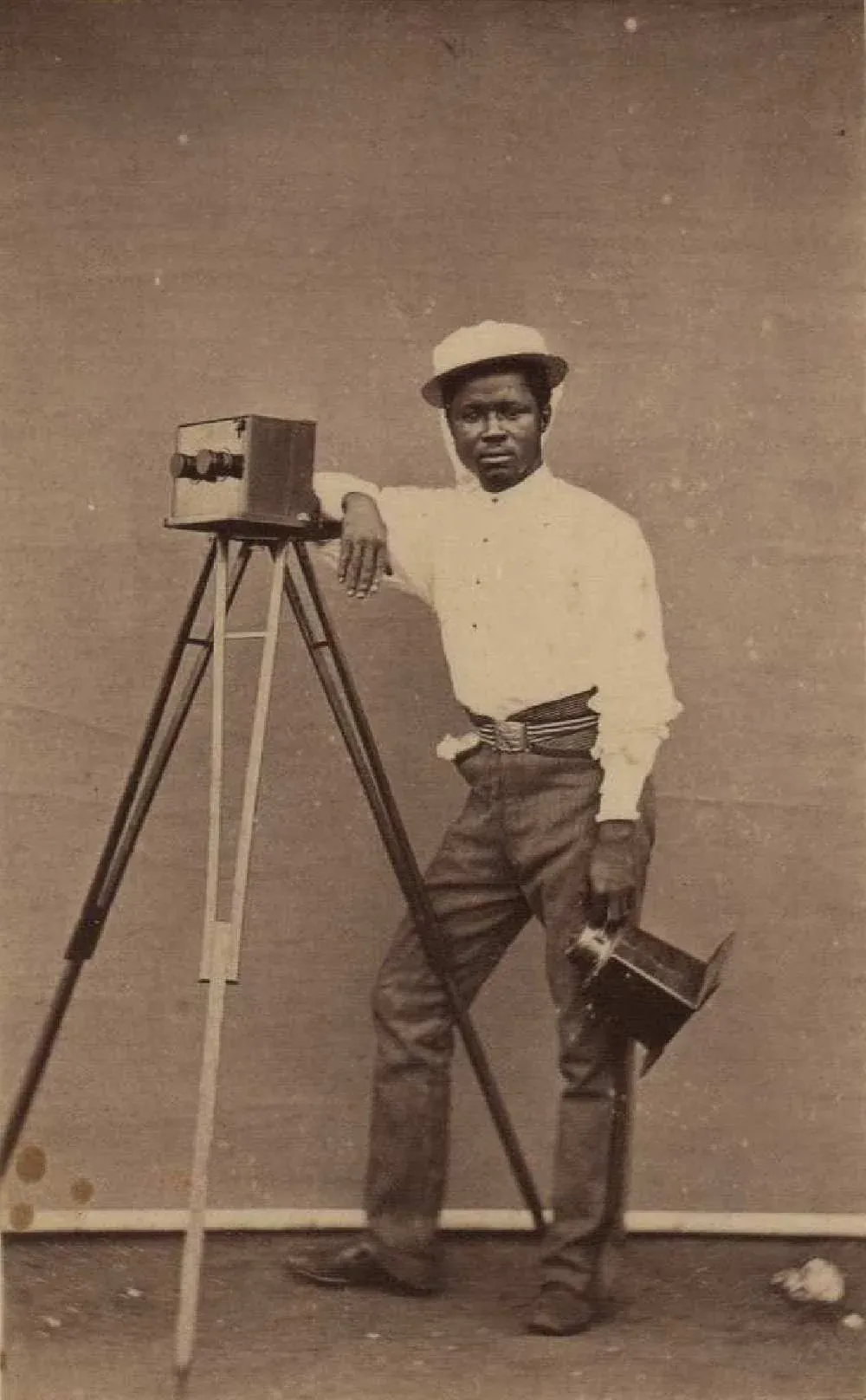
Joaque studied at the Church Missionary Society school in Freetown, then spent two years in the navy aboard HMS Rattlesnake. He went on to become purser aboard the Corra Linn, the steamer of the British governor of Sierra Leone.7Jürg Schneider, "Demand and Supply: Francis W. Joaque, an Early African Photographer in an Emerging Market," Visual Anthropology , vol. 27, no. 4, 2014, pp. 316-338. DOI: 10.1080/08949468.2014.914848.
Between 1865 and 1890 he built his career as a photographer, moving constantly between several colonies. He temporarily closed his Freetown studio to settle in Fernando Po — a Spanish colony since 1858, today the island of Bioko in Equatorial Guinea — where the Spanish governor Diego Santisteban commissioned him, in the 1870s, to produce a series of fourteen views of Santa Isabel, the colony's capital. During these same years he also worked in Libreville, Gabon.4Jürg Schneider and Miquel Vilaró i Güell, "Fourteen Views of Fernando Po to Save the Colony," European Society for the History of Photography, 21 April 2014, p. 27.7Jürg Schneider, "Demand and Supply: Francis W. Joaque, an Early African Photographer in an Emerging Market," Visual Anthropology , vol. 27, no. 4, 2014, pp. 316-338. DOI: 10.1080/08949468.2014.914848.
Joaque eventually returned to settle in Freetown in 1890, where he reopened his studio. His death there is documented as 1 November 1895 — other, less precise biographical notices place it more broadly "around 1895–1900."7Jürg Schneider, "Demand and Supply: Francis W. Joaque, an Early African Photographer in an Emerging Market," Visual Anthropology , vol. 27, no. 4, 2014, pp. 316-338. DOI: 10.1080/08949468.2014.914848. His photographs were shown in colonial exhibitions in Libreville in 1887 and, posthumously, in Paris in 1900 — a sign of recognition that went well beyond the local sphere.2Michael Graham-Stewart and Francis McWhannell, Broad Sunlight: Early West African Photography , MGS, April 2020, p. 115.7Jürg Schneider, "Demand and Supply: Francis W. Joaque, an Early African Photographer in an Emerging Market," Visual Anthropology , vol. 27, no. 4, 2014, pp. 316-338. DOI: 10.1080/08949468.2014.914848.
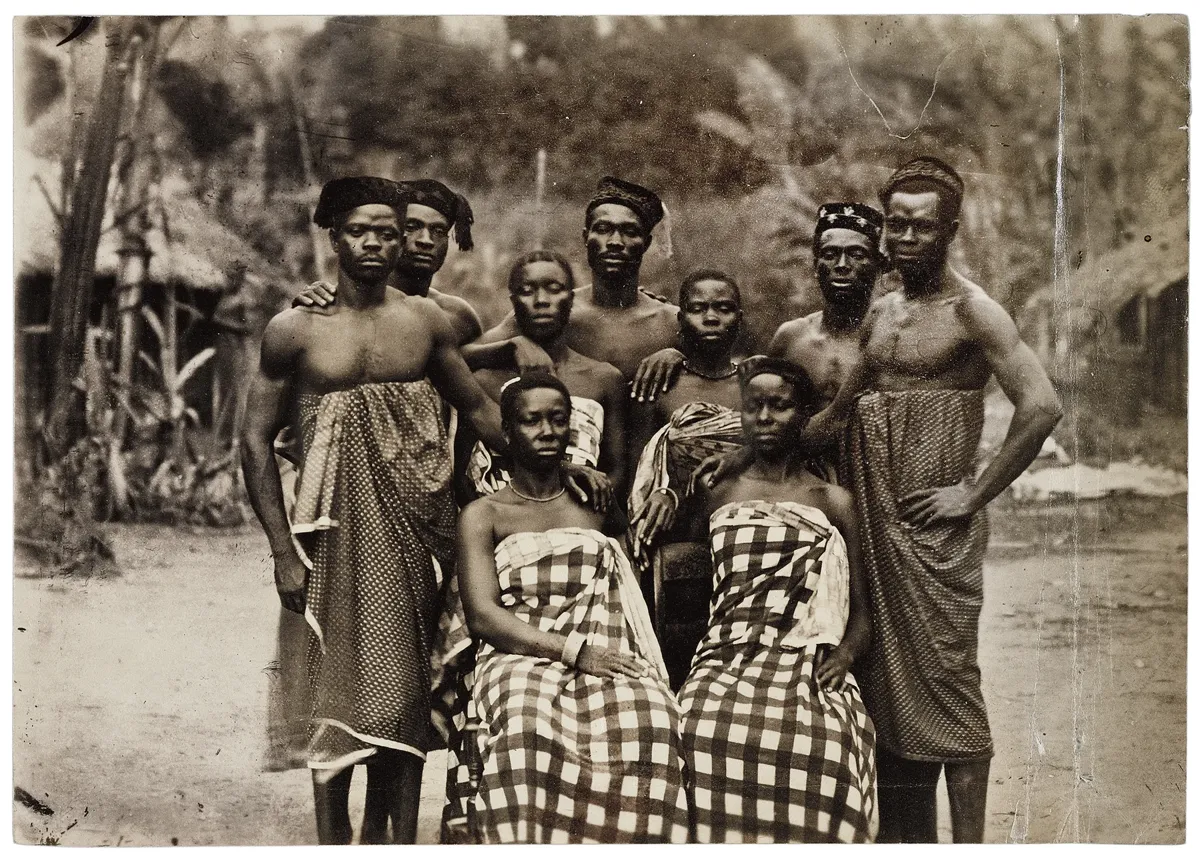
Part of Joaque's work, however, slipped out of his control once made. Several of his portraits — including chiefs from Calabar and Brass, in the Niger Delta — were reproduced as engravings in European illustrated magazines such as La Ilustración Española y Americana in Spain or Über Land und Meer in Germany, as well as in travel accounts and missionary reports.7Jürg Schneider, "Demand and Supply: Francis W. Joaque, an Early African Photographer in an Emerging Market," Visual Anthropology , vol. 27, no. 4, 2014, pp. 316-338. DOI: 10.1080/08949468.2014.914848. The African photographer produced the image; it was often the European publisher who fixed its meaning and its audience.
Yet Joaque was not an isolated case.
Why did Accra become a photography hub?
1870s – 1940s
While Joaque travelled the coast between Freetown, Fernando Po and Libreville, another studio was taking shape further east, on the Gold Coast (present-day Ghana).
In the 1870s, George Lutterodt (c. 1850/55 – c. 1904) opened, with his brothers, what is considered the country's first photography studio, in the Jamestown district of Accra.8Giulia Paoletti, "Early Histories of Photography in West Africa (1860-1910)," Heilbrunn Timeline of Art History , The Metropolitan Museum of Art, March 2017. metmuseum.org9Erin Haney, "Photographing the Gold Coast: The Lutterodt Studios," Perspectives , The Metropolitan Museum of Art, 7 December 2015. metmuseum.org Photographic activity by the family is attested in Accra from that decade onward; some accounts place the opening of a business associated with one of the sons, Albert, more precisely in 1876 — the broader decade is used here, as it is better supported by the Met's curatorial essay.9Erin Haney, "Photographing the Gold Coast: The Lutterodt Studios," Perspectives , The Metropolitan Museum of Art, 7 December 2015. metmuseum.org The Lutterodt family, of mixed Danish and Ga descent, traces back to Georg August Lutterodt, a Danish colonial official settled in Accra in the early nineteenth century and married to a Ga woman — a lineage that illustrates, like Joaque's, the complexity of identities in the coastal trading posts of the period.9Erin Haney, "Photographing the Gold Coast: The Lutterodt Studios," Perspectives , The Metropolitan Museum of Art, 7 December 2015. metmuseum.org
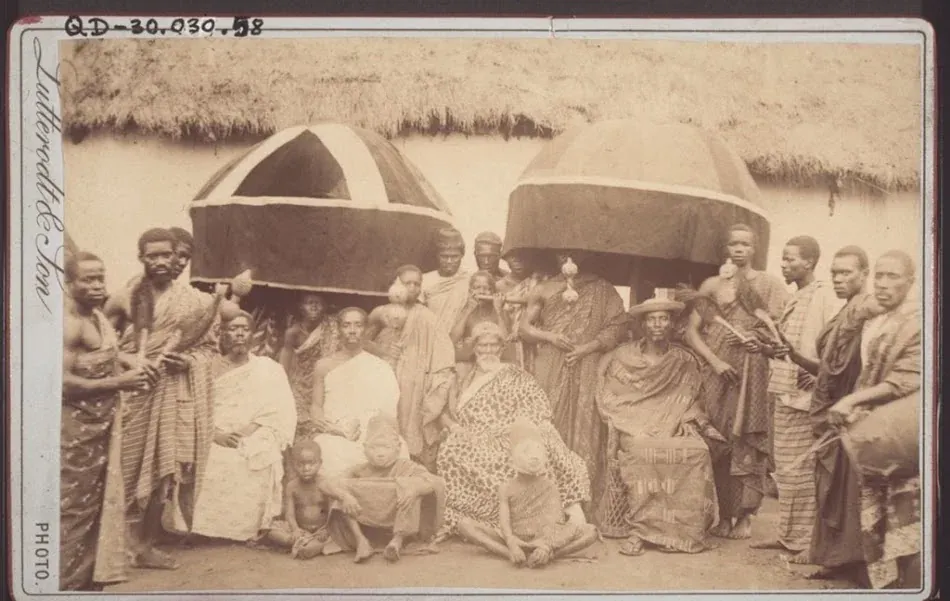
This image deserves more than a passing glance. King Taki II occupies the centre of the frame, seated and surrounded by standing attendants — a composition that borrows the conventions of the European portrait of authority (frontal pose, hierarchical staging) while placing them in the service of Ga sovereignty. Nothing in the sources consulted indicates whether it was the king, his court, or the Lutterodt studio that decided on the arrangement of the figures, the clothing, or the backdrop: the photograph documents a negotiation between subject and photographer as much as it does a simple record of reality. It is a question worth asking of every image in this article: who chose the pose, who looks at the lens — and who, by contrast, is left out of it?
The Lutterodt studio did not stay confined to Accra: the family ran travelling studios along the coast, in Cape Coast, in Elmina, as far as Freetown and the Bight of Benin, training new West African photographers along the way — among them, it seems, the Togolese photographer Alex Agbaglo Acolatse, who would go on to open his own studio in Lomé.9Erin Haney, "Photographing the Gold Coast: The Lutterodt Studios," Perspectives , The Metropolitan Museum of Art, 7 December 2015. metmuseum.org
The Lutterodt dynasty endured in Accra into the 1940s — close to seventy years of continuous activity, across several generations.9Erin Haney, "Photographing the Gold Coast: The Lutterodt Studios," Perspectives , The Metropolitan Museum of Art, 7 December 2015. metmuseum.org
Who were the Lisk-Carew brothers?
1893 – 1959
It is in Freetown, precisely, that this first generation of African photographers closes the loop opened by Jules Itier in 1842.
In 1893, William Stephen Johnston established his own studio there, W. S. Johnston & Sons — one of the very first studios run continuously by a local photographer in the city.11Vera Viditz-Ward, "Photography in Sierra Leone, 1850-1918," Africa , vol. 57, no. 4, 1987, pp. 510-518. Twelve years later, around 1905 — some trade notices place the opening as early as 1903 — one of his former apprentices, Alphonso Lisk-Carew, in turn opened a studio with his brother Arthur, under the name "Lisk-Carew Brothers" — at 3 East Brook Lane, on the corner of Westmoreland and Gloucester streets.12Julie Crooks, "Alphonso Lisk-Carew: Imaging Sierra Leone Through his Lens," African Arts , vol. 48, no. 3, 2015, pp. 18-27; and Julie Crooks, "Reinforcing Sierra Leonean Identity: Alphonso Lisk-Carew," Perspectives , The Metropolitan Museum of Art, 30 December 2015. metmuseum.org13"Lisk-Carew Brothers (fl. 1905-1959)," ArchiveSearch, Cambridge University Library, citing Allister Macmillan (ed.), The Red Book of West Africa , Frank Cass, 1920, p. 267.
Alphonso Lisk-Carew would go on to a career spanning more than fifty years, making him one of the most prolific and best-documented photographers of this generation.12Julie Crooks, "Alphonso Lisk-Carew: Imaging Sierra Leone Through his Lens," African Arts , vol. 48, no. 3, 2015, pp. 18-27; and Julie Crooks, "Reinforcing Sierra Leonean Identity: Alphonso Lisk-Carew," Perspectives , The Metropolitan Museum of Art, 30 December 2015. metmuseum.org
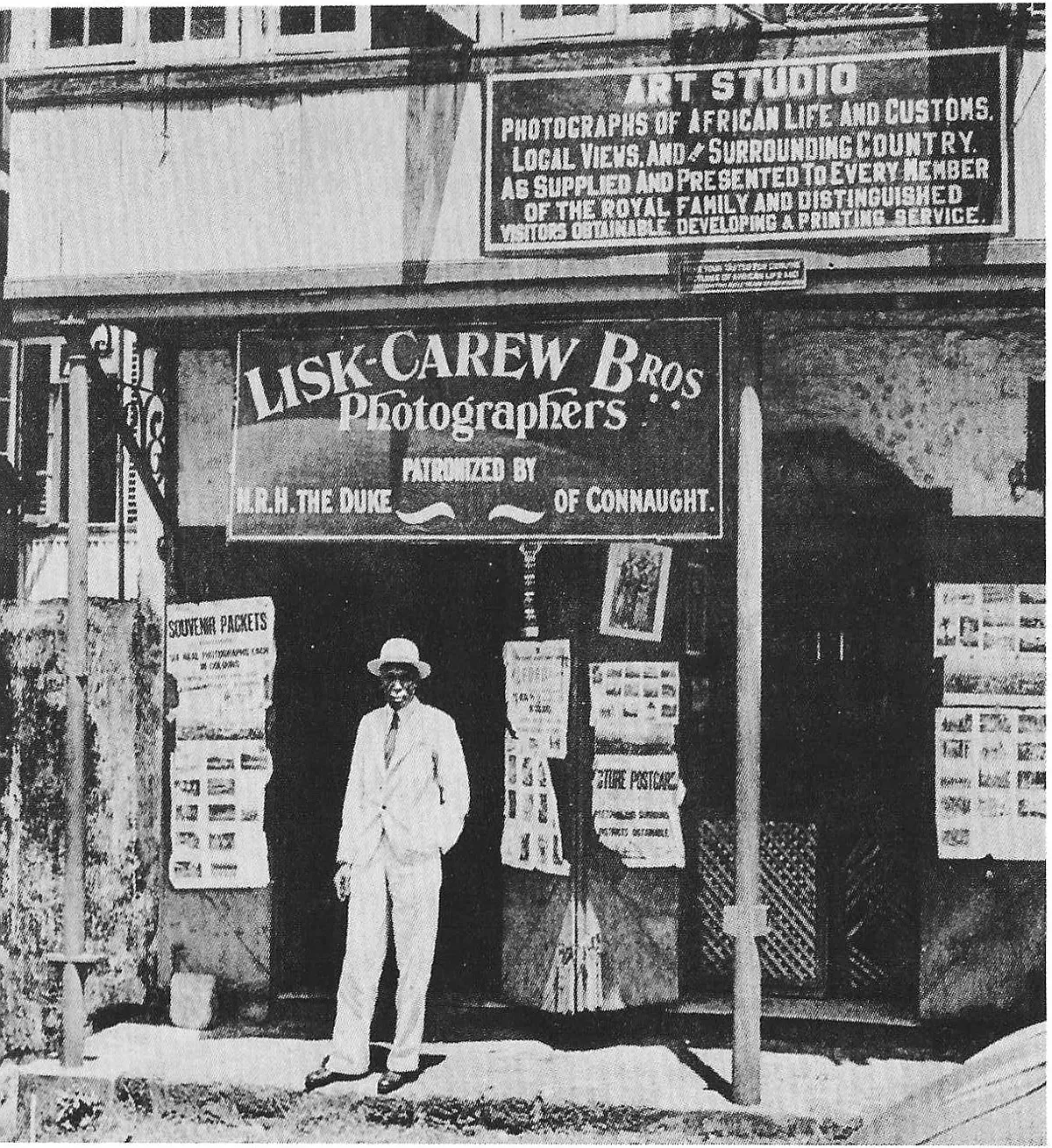
The Lisk-Carews served a clientele both Creole and European: formal studio portraits, but also photographs of official events — they would be named the official photographers for the Duke of Connaught's 1910 visit — and photographic expeditions into the interior and as far as Banjul, in Gambia.12Julie Crooks, "Alphonso Lisk-Carew: Imaging Sierra Leone Through his Lens," African Arts , vol. 48, no. 3, 2015, pp. 18-27; and Julie Crooks, "Reinforcing Sierra Leonean Identity: Alphonso Lisk-Carew," Perspectives , The Metropolitan Museum of Art, 30 December 2015. metmuseum.org13"Lisk-Carew Brothers (fl. 1905-1959)," ArchiveSearch, Cambridge University Library, citing Allister Macmillan (ed.), The Red Book of West Africa , Frank Cass, 1920, p. 267.
A growing share of their output circulated as postcards from the 1900s onward — a commercial format that reached a far wider public than the individual studio portrait, but which also shifted control over the image, once again, into the hands of the publisher and the buyer.13"Lisk-Carew Brothers (fl. 1905-1959)," ArchiveSearch, Cambridge University Library, citing Allister Macmillan (ed.), The Red Book of West Africa , Frank Cass, 1920, p. 267.
A wider network still
1860s – 1905
Joaque, the Lutterodts and the Lisk-Carews were not isolated cases. The same generation includes, among others, the Gambian John Parkes Decker (active from at least 1867 to 1890, an itinerant photographer from Dakar to Cameroon, commissioned by the British colonial authorities to document the buildings of Freetown), Neils Walwin Holm (trained on the Gold Coast, settled in Lagos in 1886, one of the first to use dry plates there), and Jonathan Adagogo Green (born 1873 in Bonny, in the Niger Delta, trained in Sierra Leone and then in the United Kingdom, active from 1891 until his death in 1905).15Erin Haney, Photography and Africa , Reaktion Books, 2010, pp. 3-34.16Jürg Schneider, "The Topography of the Early History of African Photography," History of Photography , vol. 34, no. 2, 2010, pp. 134-146. (already cited in episode 2)
Together, these photographers wove, between the 1860s and 1900, a web of studios covering nearly the whole West African coast.
From Joaque opening his first studio in Freetown to the Lisk-Carew brothers opening theirs in the same city, forty years later. Original infographic, BEWEGT CREATIVE STUDIO.
Could photography already be called African?
Taking stock, 1865–1905
Let us return to the question left open at the end of the previous episode: from what point can we speak of a truly African photography?
On one criterion at least, the answer here is unambiguous: Joaque, the Lutterodts, the Lisk-Carews and their contemporaries were born in West Africa, grew up there, learned and practised their craft there, and often passed their know-how on to other Africans — a clean break from Itier, a passing official, or even from Washington, trained and acculturated in the United States before settling in Liberia.
But this criterion of birth alone is not enough to settle the question. The real paradox of this period lies elsewhere: African photographers gained increasing control over the production of their images, yet still worked within political, economic and editorial systems that limited their control over how those images circulated. A single image could thus be African by its author, local through part of its clientele, colonial through the context of its commission, and European through its mode of publication — all four at once, without contradiction.
The historian Giulia Paoletti, for her part, cautions against stopping at this criterion of birth alone. The best-documented case of this paradox is Joaque's: part of his work was reproduced, without his control, as engravings in European illustrated magazines and missionary reports.7Jürg Schneider, "Demand and Supply: Francis W. Joaque, an Early African Photographer in an Emerging Market," Visual Anthropology , vol. 27, no. 4, 2014, pp. 316-338. DOI: 10.1080/08949468.2014.914848. The Lisk-Carews saw a comparable dynamic from the 1900s onward, as a growing share of their output circulated as commercial postcards — objects whose captions, publishers and sales channels could reshape their meaning, well beyond the commercial success of the studio they attest to.13"Lisk-Carew Brothers (fl. 1905-1959)," ArchiveSearch, Cambridge University Library, citing Allister Macmillan (ed.), The Red Book of West Africa , Frank Cass, 1920, p. 267. For the Lutterodts, by contrast, the sources consulted document mainly a local clientele and local circulation; nothing at this stage points to a comparable uptake by European publishers. Photography by Africans does not, then, automatically overlap in this period with photography made for African audiences, nor with photography controlled from end to end by Africans — but this holds to very different degrees from one studio to the next.
As the twentieth century opened, the cameras were now in African hands. So were the studios. What still escaped the photographers was often the fate of their images once they left the studio. From now on, it would increasingly be postcards, publishers and the global trade in images that decided how those images circulated. That is the story the next episode will tell.
A note on method — text: sixteen sources document this article, all academic, curatorial or archival (Indiana University Press, MGS, the European Society for the History of Photography, John Wiley & Sons, Visual Anthropology, The Metropolitan Museum of Art, the journal Africa, African Arts, Cambridge University Library, Reaktion Books, History of Photography) — excluding any collaborative encyclopedia as a factual source. Three references (Schneider 2014 in Visual Anthropology, Viditz-Ward 1987 in Africa, and the Cambridge University Library archive record) could not be read in full from this writing environment: their bibliographic citations are verified, but some precise details come from secondary scholarly summaries rather than a direct reading of the source text. Images: four public-domain archival photographs, each verified individually on its Wikimedia Commons file page — including the Lisk-Carew studio facade, whose exact file was confirmed by tracing it back to the Syracuse University collections. The two infographics (studio network, timeline) are original illustrations made for this article.
Sources
- Jürg Schneider, Portraiture and Photography in Africa, Indiana University Press, 2013, p. 49. ↩
- Michael Graham-Stewart and Francis McWhannell, Broad Sunlight: Early West African Photography, MGS, April 2020, p. 115. ↩
- "Francis W. Joaque, photographer in Fernando Pó, c. 1890." Wikimedia Commons. commons.wikimedia.org — public domain. ↩
- Jürg Schneider and Miquel Vilaró i Güell, "Fourteen Views of Fernando Po to Save the Colony," European Society for the History of Photography, 21 April 2014, p. 27. ↩
- Christraud M. Geary, "Roots and Routes of African Photographic Practices," in A Companion to Modern African Art, John Wiley & Sons, 2013, p. 80. ↩
- "Francis W. Joaque - Group of African men and women, Gabon, Batanga, ca. 1870." Wikimedia Commons. commons.wikimedia.org — public domain. ↩
- Jürg Schneider, "Demand and Supply: Francis W. Joaque, an Early African Photographer in an Emerging Market," Visual Anthropology, vol. 27, no. 4, 2014, pp. 316-338. DOI: 10.1080/08949468.2014.914848. ↩
- Giulia Paoletti, "Early Histories of Photography in West Africa (1860-1910)," Heilbrunn Timeline of Art History, The Metropolitan Museum of Art, March 2017. metmuseum.org ↩
- Erin Haney, "Photographing the Gold Coast: The Lutterodt Studios," Perspectives, The Metropolitan Museum of Art, 7 December 2015. metmuseum.org ↩
- "King Taki II, the king of Accra, with some of his servants, 1891," Lutterodt & Son studio. Wikimedia Commons. commons.wikimedia.org — public domain. ↩
- Vera Viditz-Ward, "Photography in Sierra Leone, 1850-1918," Africa, vol. 57, no. 4, 1987, pp. 510-518. ↩
- Julie Crooks, "Alphonso Lisk-Carew: Imaging Sierra Leone Through his Lens," African Arts, vol. 48, no. 3, 2015, pp. 18-27; and Julie Crooks, "Reinforcing Sierra Leonean Identity: Alphonso Lisk-Carew," Perspectives, The Metropolitan Museum of Art, 30 December 2015. metmuseum.org ↩
- "Lisk-Carew Brothers (fl. 1905-1959)," ArchiveSearch, Cambridge University Library, citing Allister Macmillan (ed.), The Red Book of West Africa, Frank Cass, 1920, p. 267. ↩
- "Studio of Lisk-Carew Bros., Freetown," c. 1938. Myrta and Emory Ross Collection of African Photographs, Syracuse University Libraries; published in Christraud M. Geary, Postcards from Africa: Photographers of the Colonial Era, MFA Publications, 2018. Wikimedia Commons. commons.wikimedia.org — public domain. ↩
- Erin Haney, Photography and Africa, Reaktion Books, 2010, pp. 3-34. ↩
- Jürg Schneider, "The Topography of the Early History of African Photography," History of Photography, vol. 34, no. 2, 2010, pp. 134-146. (already cited in episode 2) ↩
.jpg)


Further reading
- Jürg Schneider and Erin Haney (eds.), Early Photographies in West Africa, Taylor & Francis, 2014.
- Erin Haney, Photography and Africa, Reaktion Books, 2010, pp. 3-34.
- Michael Graham-Stewart and Francis McWhannell, Broad Sunlight: Early West African Photography, MGS, 2020.
- Christraud M. Geary and Virginia-Lee Webb (eds.), Delivering Views: Distant Cultures in Early Postcards, Smithsonian Institution Press, 1998.
- Giulia Paoletti, Portrait and Place: Photography in Senegal, 1840-1960, Princeton University Press, 2024.
Comments
Be the first to comment