


Take a postcard from this period. Turn it over.
On the front, a photograph — a market, a portrait, a street in Freetown or Lomé. On the back, a printed line, a serial number, a publisher's name. Nothing indicates who took the photograph. Often, no one knows anymore.
It is the most ordinary object in the history of photography in Africa, and one of the most consequential. At the end of the previous episode, we left the West African photographers in command of their studios but dispossessed of the fate of their images. The postcard is the object where this question plays out at industrial scale — and, in the same movement, a trade in which some of them thrived.
Both things are true at once. That is the whole interest of the period.
Why 1900?
Technical and commercial conditions, 1893-1914
Two processes make the illustrated postcard commercially viable between 1893 and 1920: lithography and, above all, collotype (phototype), which reproduces a photograph's tonal range with a fineness close to the original print.1On the processes and chronology: lithography and collotype (phototype) are the two techniques responsible for most illustrated postcards printed between 1893 and 1920; German printers dominate the world market for quality postcards as subcontractors for foreign publishers, until this export trade is interrupted in 1914. University of Maryland Libraries, exhibition "Postcards: Printing Technology." exhibitions.lib.umd.edu ; Smithsonian Institution Archives, "Postcard History." siarchives.si.edu A photographic image can now be reproduced in tens of thousands of copies for almost nothing.
The centre of gravity of this industry is German: German printers dominate the world market for quality postcards, working as subcontractors for foreign publishers, until the war cuts these circuits in 1914.1On the processes and chronology: lithography and collotype (phototype) are the two techniques responsible for most illustrated postcards printed between 1893 and 1920; German printers dominate the world market for quality postcards as subcontractors for foreign publishers, until this export trade is interrupted in 1914. University of Maryland Libraries, exhibition "Postcards: Printing Technology." exhibitions.lib.umd.edu ; Smithsonian Institution Archives, "Postcard History." siarchives.si.edu Collectors call 1900-1914 the golden age of the postcard.
Five stages link the African shot to the sale of the printed card, back from Europe. The "Publishing" stage, the only one in solid dark colour, is where the image's meaning is fixed — that is where the eye goes first. A typical circuit, not the documented route of any single card. Original infographic, BEWEGT CREATIVE STUDIO.
The material detail has a considerable consequence. A negative made in Lomé could be sent to a European printer to be turned, by collotype or lithography, into hundreds or thousands of postcards. The printed copies then came back to Africa, were sold in trading posts, shops and studios, and set off again with travellers, administrators, merchants or collectors. The production chain of the African image now stretched across several territories. Between the shot and the recipient's gaze stood the publisher, the printer, the caption, the serial number and the market.
Who Published These Images?
The great colonial publishers, 1900-1930
Negatives head to European printers; the printed cards come back, sell locally, then set off for good with travellers and collectors. A schematic map, with no geographic precision. Original infographic, BEWEGT CREATIVE STUDIO.
The reference work on this production is that of historian Christraud M. Geary, curator at the Museum of Fine Arts, Boston, who devoted two books to it twenty years apart: Delivering Views (1998), co-edited with Virginia-Lee Webb, then Postcards from Africa (2018), drawn from the Leonard A. Lauder collection held at the MFA.2Christraud M. Geary, Postcards from Africa: Photographers of the Colonial Era. Selections from the Leonard A. Lauder Postcard Archive , MFA Publications, Museum of Fine Arts, Boston, 2018; Christraud M. Geary and Virginia-Lee Webb (eds.), Delivering Views: Distant Cultures in Early Postcards , Smithsonian Institution Press, 1998. On Geary's historiographical contribution — a less binary reading of colonial images, attentive to nuanced power relations: review in African Arts , vol. 53, no. 1, MIT Press, 2020, p. 93. direct.mit.edu
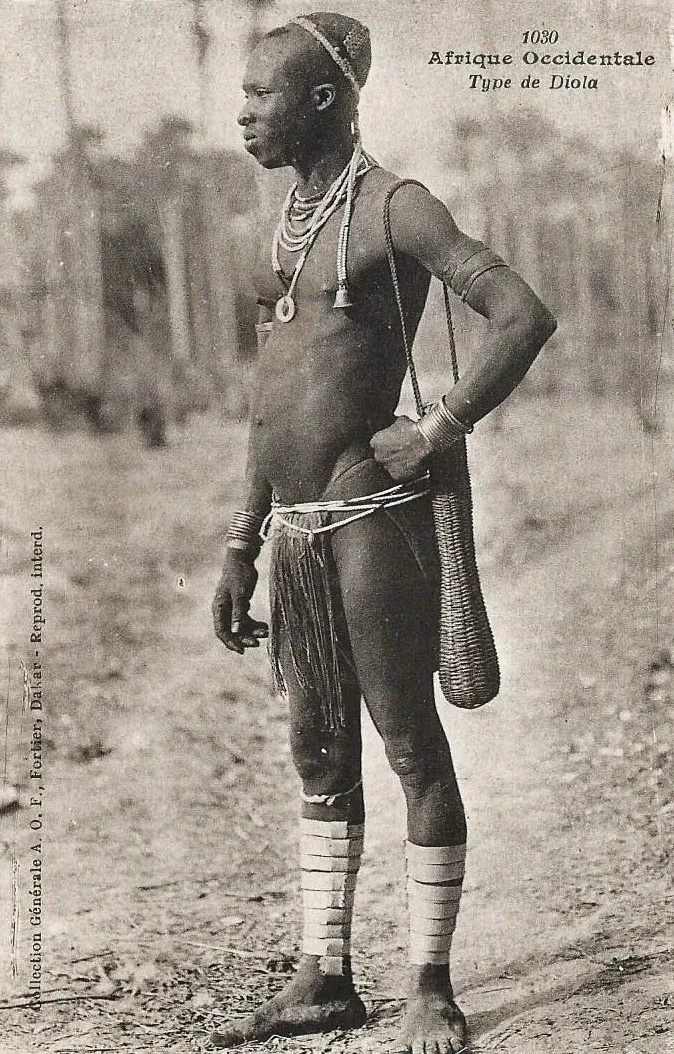
Geary traces the biographies of the European and African practitioners who fed this trade across the French, German and British empires. Among them, François-Edmond Fortier (1862-1928) is the best-documented case in French West Africa. The Metropolitan Museum describes him as one of the most prolific European photographers in the region: active between 1900 and 1912, he produced at least three thousand negatives, many of them printed as postcards he kept reissuing into the early 1920s.3On François-Edmond Fortier (1862-1928) — one of the most prolific European photographers in French West Africa, active between 1900 and 1912, at least three thousand negatives many of them printed as postcards reissued into the early 1920s; ethnographic approach aimed almost exclusively at foreign communities in Africa and European audiences; his cards' presence in Picasso's collection: collection records and essays from the Metropolitan Museum of Art. metmuseum.org The Met also specifies the orientation of his work — an ethnographic approach, aimed almost exclusively at foreign communities settled in Africa and at his compatriots back in Europe.3On François-Edmond Fortier (1862-1928) — one of the most prolific European photographers in French West Africa, active between 1900 and 1912, at least three thousand negatives many of them printed as postcards reissued into the early 1920s; ethnographic approach aimed almost exclusively at foreign communities in Africa and European audiences; his cards' presence in Picasso's collection: collection records and essays from the Metropolitan Museum of Art. metmuseum.org
This last point deserves emphasis. Fortier does not photograph for the Africans he photographs. His clientele is elsewhere, and that determines everything: the choice of subjects, the staging, and above all how they are named.
One detail usefully complicates the portrait: Fortier, born in the Vosges in 1862, died in Dakar in 1928.3On François-Edmond Fortier (1862-1928) — one of the most prolific European photographers in French West Africa, active between 1900 and 1912, at least three thousand negatives many of them printed as postcards reissued into the early 1920s; ethnographic approach aimed almost exclusively at foreign communities in Africa and European audiences; his cards' presence in Picasso's collection: collection records and essays from the Metropolitan Museum of Art. metmuseum.org The man who sold French West Africa to Europeans spent his life there, and is buried there.
What About African Photographers?
Lisk-Carew, Acolatse, 1900-1930
They are in this trade. Not at its margin: at its centre.
Take the Lisk-Carew brothers again, whose settling in Freetown in the early 1900s we followed earlier. Their studio did not stop at portraits. It published its own postcards — a production estimated at more than three thousand, with historian Julie Crooks herself pointing out the difficulty of establishing an exact number — and also sold stationery and novelty items.4On the Lisk-Carews as postcard publishers: Julie Crooks, "Alphonso Lisk-Carew: Imaging Sierra Leone Through his Lens," African Arts , vol. 48, no. 3, 2015, pp. 18-27 — the estimate of more than three thousand cards is presented there as an order of magnitude, the author noting the difficulty of establishing an exact figure (already cited in episode 3) . See also "Lisk-Carew Brothers (fl. 1905-1959)," ArchiveSearch, Cambridge University Library; Library of Congress, Africana Historic Postcard Collection; The Metropolitan Museum of Art, Bundoo Girls, Sierra Leone . Their cards are held today in the Library of Congress's Africana Historic Postcard Collection; the Metropolitan Museum holds their group portrait Bundoo Girls, Sierra Leone.4On the Lisk-Carews as postcard publishers: Julie Crooks, "Alphonso Lisk-Carew: Imaging Sierra Leone Through his Lens," African Arts , vol. 48, no. 3, 2015, pp. 18-27 — the estimate of more than three thousand cards is presented there as an order of magnitude, the author noting the difficulty of establishing an exact figure (already cited in episode 3) . See also "Lisk-Carew Brothers (fl. 1905-1959)," ArchiveSearch, Cambridge University Library; Library of Congress, Africana Historic Postcard Collection; The Metropolitan Museum of Art, Bundoo Girls, Sierra Leone .
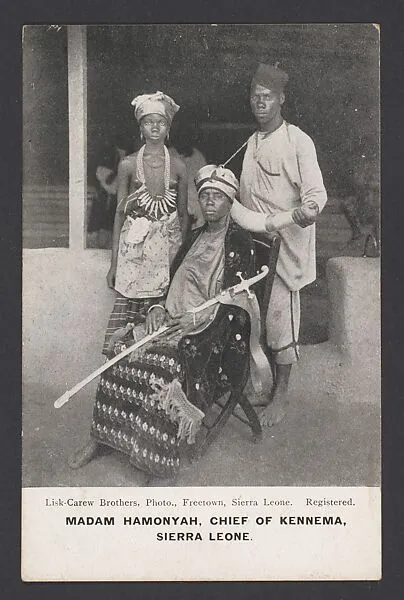
A West African studio, run by two Creole brothers, self-publishing several thousand postcards for an international market: the line "Europeans took control of the African image" does not hold as it stands.
The second case picks up directly where episode 3 left off. Alex Agbaglo Acolatse (1880-1975) trained within the network of Lutterodt photographers, the Accra dynasty whose itinerant studios along the coast we followed earlier, then set up his own practice in Togo around 1900. Active for several decades — the Metropolitan Museum holds negatives dated 1909, the 1910s and the 1920s — he photographed the elites and the social and political life of the country, made numerous self-portraits, and also published postcards, notably in the 1920s.5On Alex Agbaglo Acolatse (1880-1975) — trained within the network of Lutterodt photographers, established his practice in Togo around 1900, negatives held dated 1909, the 1910s and the 1920s, self-portraits, postcards published notably in the 1920s, works held at the Metropolitan Museum of Art and the Museum Rietberg in Zurich: collection records from the Metropolitan Museum of Art. metmuseum.org His work is held today at the Met and at the Museum Rietberg in Zurich.5On Alex Agbaglo Acolatse (1880-1975) — trained within the network of Lutterodt photographers, established his practice in Togo around 1900, negatives held dated 1909, the 1910s and the 1920s, self-portraits, postcards published notably in the 1920s, works held at the Metropolitan Museum of Art and the Museum Rietberg in Zurich: collection records from the Metropolitan Museum of Art. metmuseum.org
A Togolese photographer, trained by a Ghanaian family, documenting his country's society for half a century and selling part of his output on the postcard market. The West African network described in the previous episode did not collapse in the face of the European industry. It plugged into it.
What the Caption Does to the Image
The shift of meaning, 1900-1920
This is where another form of control over the image plays out: no longer only in the shot, but in the text that accompanies it.
A studio photograph shows a person who chose their clothing, their pose, and the moment of being photographed. Printed as a postcard, numbered within a series and captioned with an ethnonym, the same image stops being a portrait. It becomes a specimen.
This is not a theoretical reconstruction. Here are real captions, as they appear on cards held at the Metropolitan Museum of Art.
The Caption, Word for Word
"Afrique Occidentale — Jeunes Filles Ouolof" [West Africa — Young Wolof Girls] Postcard, 1900-1912, attributed to François-Edmond Fortier.6"Afrique Occidentale, Jeunes Filles Ouolof" [West Africa, young Wolof girls], 1900-1912, attributed to François-Edmond Fortier. The Metropolitan Museum of Art. metmuseum.org — the attribution is given as probable by the museum.
"Afrique Occidentale — Danseurs 'Miniankas' — Fétiches des Cultures" [West Africa — 'Minianka' Dancers — Cult Fetishes] Postcard, 1905-1906, François-Edmond Fortier.7"Afrique Occidentale — Danseurs 'Miniankas' — Fétiches des Cultures," 1905-1906, François-Edmond Fortier. Photomechanical print, 13.3 × 8.3 cm, classified "Postcards." Visual Resource Archive, The Michael C. Rockefeller Wing, The Metropolitan Museum of Art, object no. VRA.PC.AF.017. metmuseum.org — the image of this card is not freely accessible: we quote its caption without reproducing it.
Look at what these few words accomplish.
The place disappears. "Afrique Occidentale" designates French West Africa — more than four million square kilometres, eight territories. No city, no village, no address. The photograph was indeed taken somewhere; the caption dissolves it.
The name disappears. No one is named. In its place, an ethnonym — "Wolof," "Minianka" — that replaces identity with belonging. These women are not people who agreed to be photographed: they are specimens of a category.
The plural takes over. "Young Girls," "Dancers." Never one young girl, never one dancer. The grammar itself forbids the individual.
The vocabulary judges. "Fétiches" is not a neutral descriptive term: it is a word from colonial literature, one that classifies a religious practice as superstition.
The operation is purely editorial. No retouching, no cropping: a line of text and a serial number are enough. This is why the colonial postcard is such a troubling object to study — the photograph it contains can be technically excellent, and sometimes even the fruit of a genuine understanding between the photographer and their subject, while the apparatus surrounding it turns it inside out entirely.
It is the question raised about the portrait of King Taki II in the previous episode — who chose the pose, who looks at the lens — shifted one notch further. Here, the one who decides is neither the photographer nor the subject.
Key Takeaways
| 1893-1920 | Lithography and collotype make mass distribution possible |
| 1900-1914 | Golden age of the postcard; German printers dominate |
| Fortier | 3,000 negatives, an exclusively European clientele |
| Lisk-Carew | African studio, ~3,000 cards self-published |
| Acolatse | Active from 1900, half a century of practice, cards in the 1920s |
| The shift | It plays out in the caption and the serial number |
What Changed
Stock-taking, 1900-1920
Between 1865 and 1905, the question was: who holds the camera? The answer had increasingly become: an African.
Between 1900 and 1920, the question shifts: who decides what the image means, and how far it travels? African studios produce, publish and sell — but within an economy whose presses, catalogues and descriptive vocabulary lie elsewhere.
Beware the easy conclusion. Lisk-Carew and Acolatse are not victims of the postcard trade: they are entrepreneurs who used it, made a living from it, and circulated their images at a scale no nineteenth-century studio could have reached. But their name tends to fade along the way — even in today's catalogues, where the collector's name sometimes precedes the photographer's.
In the following decades, the centre of gravity will gradually shift. A new generation of studios will work first for urban African clienteles, who will come to be photographed for themselves, their families and their communities. In Bamako, Dakar or Kinshasa, the studio will become one of the places where modern African societies make their own image.
Methodological note — text: nine sources document this article, seven of them academic, curatorial or archival (Museum of Fine Arts, Boston; Metropolitan Museum of Art; Library of Congress; Cambridge University Library; Smithsonian Institution Press; MIT Press; University of Maryland Libraries; Smithsonian Institution Archives) — no crowdsourced encyclopedia was used as a source of fact. The two postcard captions quoted verbatim come from Metropolitan Museum of Art records; the card they describe is not freely accessible and is therefore not reproduced here. Images: two period postcards, each individually verified on its Wikimedia Commons page and confirmed to be in the public domain. The three infographics (production chain, timeline, outbound circuit) are original illustrations made for this article, drawn solely from the data sourced above.
Sources
- On the processes and chronology: lithography and collotype (phototype) are the two techniques responsible for most illustrated postcards printed between 1893 and 1920; German printers dominate the world market for quality postcards as subcontractors for foreign publishers, until this export trade is interrupted in 1914. University of Maryland Libraries, exhibition "Postcards: Printing Technology." exhibitions.lib.umd.edu; Smithsonian Institution Archives, "Postcard History." siarchives.si.edu ↩
- Christraud M. Geary, Postcards from Africa: Photographers of the Colonial Era. Selections from the Leonard A. Lauder Postcard Archive, MFA Publications, Museum of Fine Arts, Boston, 2018; Christraud M. Geary and Virginia-Lee Webb (eds.), Delivering Views: Distant Cultures in Early Postcards, Smithsonian Institution Press, 1998. On Geary's historiographical contribution — a less binary reading of colonial images, attentive to nuanced power relations: review in African Arts, vol. 53, no. 1, MIT Press, 2020, p. 93. direct.mit.edu ↩
- On François-Edmond Fortier (1862-1928) — one of the most prolific European photographers in French West Africa, active between 1900 and 1912, at least three thousand negatives many of them printed as postcards reissued into the early 1920s; ethnographic approach aimed almost exclusively at foreign communities in Africa and European audiences; his cards' presence in Picasso's collection: collection records and essays from the Metropolitan Museum of Art. metmuseum.org ↩
- On the Lisk-Carews as postcard publishers: Julie Crooks, "Alphonso Lisk-Carew: Imaging Sierra Leone Through his Lens," African Arts, vol. 48, no. 3, 2015, pp. 18-27 — the estimate of more than three thousand cards is presented there as an order of magnitude, the author noting the difficulty of establishing an exact figure (already cited in episode 3). See also "Lisk-Carew Brothers (fl. 1905-1959)," ArchiveSearch, Cambridge University Library; Library of Congress, Africana Historic Postcard Collection; The Metropolitan Museum of Art, Bundoo Girls, Sierra Leone. ↩
- On Alex Agbaglo Acolatse (1880-1975) — trained within the network of Lutterodt photographers, established his practice in Togo around 1900, negatives held dated 1909, the 1910s and the 1920s, self-portraits, postcards published notably in the 1920s, works held at the Metropolitan Museum of Art and the Museum Rietberg in Zurich: collection records from the Metropolitan Museum of Art. metmuseum.org ↩
- "Afrique Occidentale, Jeunes Filles Ouolof" [West Africa, young Wolof girls], 1900-1912, attributed to François-Edmond Fortier. The Metropolitan Museum of Art. metmuseum.org — the attribution is given as probable by the museum. ↩
- "Afrique Occidentale — Danseurs 'Miniankas' — Fétiches des Cultures," 1905-1906, François-Edmond Fortier. Photomechanical print, 13.3 × 8.3 cm, classified "Postcards." Visual Resource Archive, The Michael C. Rockefeller Wing, The Metropolitan Museum of Art, object no. VRA.PC.AF.017. metmuseum.org — the image of this card is not freely accessible: we quote its caption without reproducing it. ↩
- "Type de Diola," postcard, French West Africa, early twentieth century, attributed to François-Edmond Fortier. Private collection. Wikimedia Commons. commons.wikimedia.org — public domain (author died in 1928; published before 1931). ↩
- "Madam Hamonyah, chief of Kennema," postcard, 1905-1907, published by Lisk-Carew Brothers, Freetown. The Metropolitan Museum of Art, via Wikimedia Commons. commons.wikimedia.org — public domain (published before 1931). ↩
.jpg)

Further reading
- Christraud M. Geary, Postcards from Africa: Photographers of the Colonial Era, MFA Publications, 2018.
- Christraud M. Geary and Virginia-Lee Webb (eds.), Delivering Views: Distant Cultures in Early Postcards, Smithsonian Institution Press, 1998.
- Erin Haney, Photography and Africa, Reaktion Books, 2010. (already cited in episode 3)
- Jürg Schneider and Erin Haney (eds.), Early Photographies in West Africa, Taylor & Francis, 2014.
- Leonard A. Lauder Postcard Archive, Museum of Fine Arts, Boston — the collection Geary's book draws on.
Comments
Be the first to comment