


We should start by saying what it looks like, because it is disappointing.
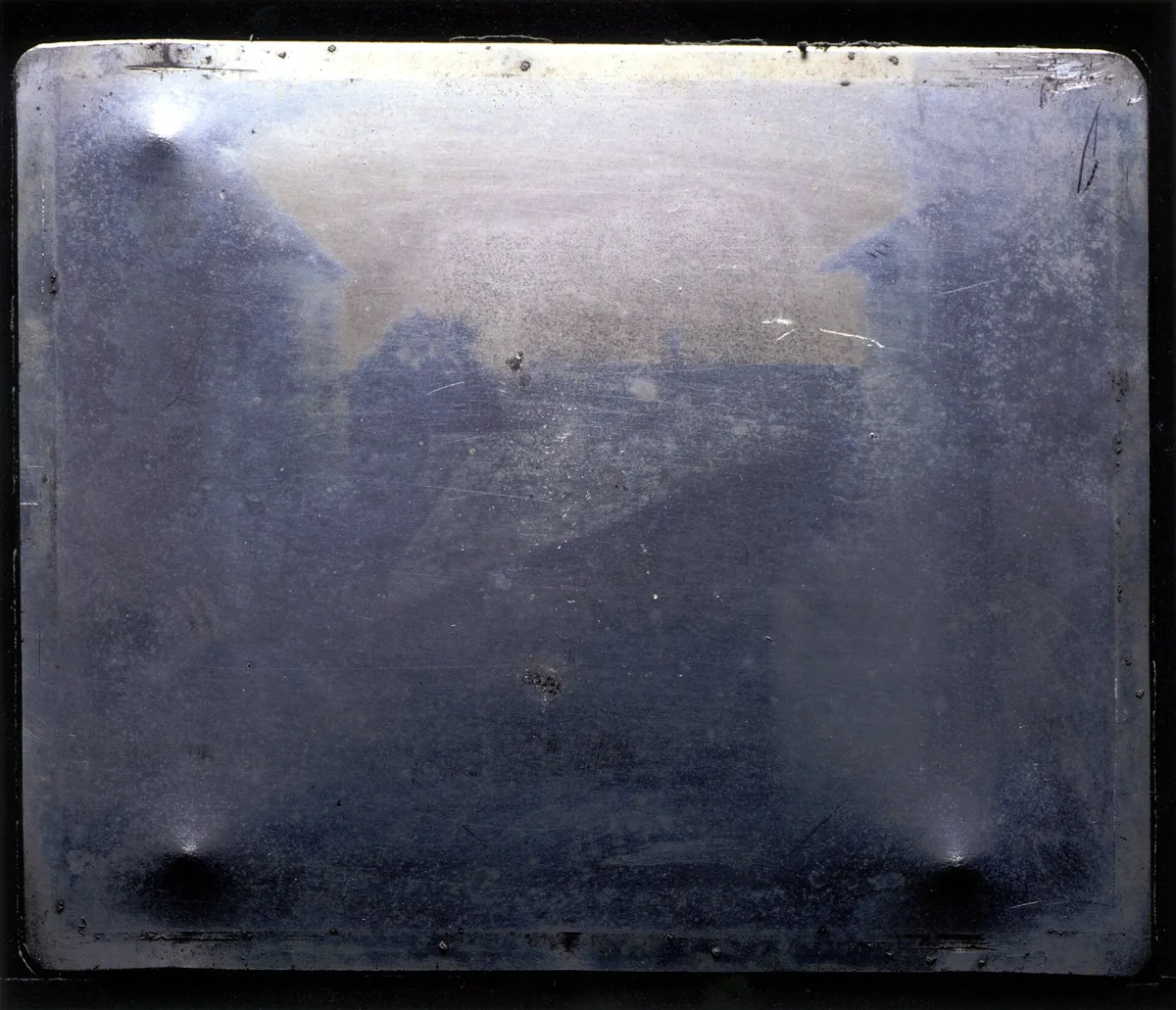
A pewter plate, 20.2 by 16.2 centimetres, coated in a brownish substance. On it, shapes that take a moment to resolve: the slope of a roof on the left, a tower or a dovecote in the middle, a tree, the wing of a barn on the right. Between them, an empty courtyard. The image is blurred, greasy, close to illegible. If someone showed it to you without a word, you would think of a botched engraving, or a stain.
It is the oldest surviving photograph in the world. It was made by a Burgundian inventor named Nicéphore Niépce, from the window of an upper room in his house at Le Gras, near Saint-Loup-de-Varennes. Today it is held at the Harry Ransom Center at the University of Texas at Austin, where it is permanently on display.1Harry Ransom Center, University of Texas at Austin, "The Niépce Heliograph", collection notice. Pewter plate sensitised with bitumen of Judea, exposure of at least eight hours. hrc.utexas.edu
And it contains an anomaly that almost nobody notices.
In which year, exactly?
Before the anomaly, a detail worth having.
You will read almost everywhere that this image dates from 1826. That is the date settled on by Helmut Gernsheim, the historian who found the plate in 1952, and it has lodged itself in every popular account. The Harry Ransom Center still displays it today.
It is probably wrong. In 1967 the historians Pierre Harmant and Paul Marillier reopened the file and argued for 1827; Gernsheim himself eventually accepted the correction in a later edition of his history of photography.2Smarthistory, "Joseph Nicéphore Niépce, View from the Window at Le Gras ". Gernsheim first settles on 1826; Pierre Harmant and Paul Marillier argue for 1827 in 1967, a dating Gernsheim accepts in a later edition of The History of Photography . smarthistory.org Current research narrows the window further, to between 4 June and 18 July 1827.
So on the most famous photograph in the world there is a one-year gap between what the institution holding it displays and what the research maintains. This is not a scandal — it is how historical knowledge normally works, a museum label moving more slowly than a scholarly article. But it is a useful warning for everything that follows: in the history of photography, the date everyone repeats is often the one written down first.
The sun that lights both sides
Now look at the shadows.
On the left-hand wall, the light comes from the right. On the building to the right, it comes from the left. Both faces of the courtyard are lit at once, which is physically impossible: one sun, one direction, at any given instant.
Except there is no given instant. That is the whole of it.
Niépce worked with bitumen of Judea, a natural asphalt spread across a pewter plate. The bitumen hardens where light strikes it; the rest, still soluble, is washed away afterwards. It is a process of unimaginable slowness — the Harry Ransom Center speaks of at least eight hours of exposure. The plate therefore did not record a moment, it recorded a duration. The sun crossed the sky while the image was forming, lighting first one façade and then the other, and the bitumen kept both.
What we call the first photograph is not an image of what could be seen through that window. It is an image of an entire day, stacked on itself. An object no human eye could ever have seen.
The founding misunderstanding
We have grown used to thinking of photography as extraction. You press, you cut out a piece of the real, you carry it away. Everyday language says so plainly: we take a picture, we capture a moment, we immortalise a scene. All those words assume that something already existed, whole, and that the camera merely seized it.
The very first image of the medium contradicts that idea before it has had time to settle. Twice, at two scales: by its duration, which compiles an entire day; by its substance, which is nothing but a dust of dots. It extracts nothing. It manufactures.
This is not some flaw of youth that technique has since cured. Every photograph you make this week rests on the same operation. A long exposure turns a river into mist — nobody has ever seen a river that way. An exposure at 1/4000th freezes a droplet into a glass bead. A telephoto lens compresses the planes. Black and white removes information that every one of your senses supplies constantly. And your sensor, like Niépce's bitumen, knows only dots.
What it changes for the person photographing
If photography does not extract but manufactures, then the question "is it faithful?" is badly put. No image is. The right question is: what am I choosing to manufacture, and why?
It is a modest shift in appearance, a considerable one in practice. It moves you from the stance of witness — I am here, I record — to the stance of author: I decide what this scene is going to become. The frame excludes more than it includes, and that exclusion is a sentence. Exposure time is not a technical setting but a statement about the nature of the world. The moment you press does not catch an instant that existed on its own; it creates one, by declaring that this is the one that counts.
Many people who describe themselves as stuck in their practice are stuck exactly there. They have learned the settings, their images are sharp and correctly exposed — and they say nothing, because they still believe themselves to be witnesses. They are waiting for the world to hand them something to record. It never does. The world supplies only raw material.
The image that nearly disappeared
One last thing, and it is not a footnote.
Niépce died in 1833 without ever profiting from his invention. His associate Louis Daguerre developed a faster and more legible process a few years later, which took his name and absorbed all the light. The Gras plate itself dropped out of circulation for decades before Gernsheim found it again in 1952, after a long search.
One hundred and twenty-five years between the moment an image is made and the moment we understand what it is.
It is a pattern that will return often in this series. Vivian Maier never showed a single one of her photographs in her lifetime. William Eggleston was demolished by the critics before being recognised as a master. Saul Leiter spent forty years preferring silence. Photography has a strange relationship with time — not only inside the image, where an entire day fits on a pewter plate, but around it too, in the delay it takes for a way of seeing to be understood.
Which should, incidentally, bring some peace to anyone photographing today without an audience.
A note on the image: the reproduction that circulates most widely is a retouched version made in 1952 to render the plate legible — the original plate, photographed as it is, is harder still to decipher. Which, all things considered, is a fitting irony for an image whose subject is manufacture.
Sources
- Harry Ransom Center, University of Texas at Austin, "The Niépce Heliograph", collection notice. Pewter plate sensitised with bitumen of Judea, exposure of at least eight hours. hrc.utexas.edu ↩
- Smarthistory, "Joseph Nicéphore Niépce, View from the Window at Le Gras". Gernsheim first settles on 1826; Pierre Harmant and Paul Marillier argue for 1827 in 1967, a dating Gernsheim accepts in a later edition of The History of Photography. smarthistory.org ↩
- Getty Conservation Institute, analysis of the Niépce heliograph, June 2002, led by Dusan Stulik. Techniques: X-ray fluorescence (XRF), Fourier-transform infrared spectrometry (FTIR), reflectance spectrophotometry. Interim GCI/HRC report, WAAC Newsletter, vol. 24 no. 3. cool.culturalheritage.org ↩
Further reading
- Geoffrey Batchen, Burning with Desire: The Conception of Photography, MIT Press, 1997. Why the idea of photography surfaced in several inventors at once around 1800.
- Helmut and Alison Gernsheim, The History of Photography, Oxford University Press, 1955 (revised 1969). The founding work, by the man who found the plate.
- Michel Frizot (ed.), A New History of Photography, Könemann, 1998. The great synthesis.
- Musée Nicéphore Niépce, Chalon-sur-Saône. The reference collection on the inventor.
Comments
Be the first to comment