


In the first episode of this series, the daguerreotype reached Africa by the most expected route: that of the orientalist travellers sent to Egypt as early as November 1839, then the colonial shipping lanes that carried it, seven years later, as far as the Cape. West Africa, by contrast, received the process by two almost contradictory paths — one carried by French commercial administration, the other by a man who chose exile to escape the second-class citizenship his own country reserved for him.
Schematic map of the shipping routes and dates of the earliest known images on the continent — Alexandria (1839), Saint-Louis (1842-1843), Monrovia (1853), Cape Town/Port Elizabeth (1846-1851). Original infographic made for this article.
A customs officer on assignment, a "missed shot" in Saint-Louis
Jules Alphonse Eugène Itier (1802-1877) was neither an artist nor a scholar by trade: born into a family of customs officers, he entered the customs administration in 1819 in Marseille, under the protection of his uncle Dubois-Aymé, a former École Polytechnique student and member of Bonaparte's Egyptian expedition.1France China Archives (Huma-Num), biographical entry "Jules Alphonse Eugène Itier." fca.huma-num.fr/s/fca/item/55 In 1842, Itier set off on a series of missions meant to promote French trade and colonial expansion — to Senegal, then Guiana, then the West Indies.1France China Archives (Huma-Num), biographical entry "Jules Alphonse Eugène Itier." fca.huma-num.fr/s/fca/item/552Alphonse-Eugène-Jules Itier, artist record, The J. Paul Getty Museum. getty.edu/art/collection/person/103KEW
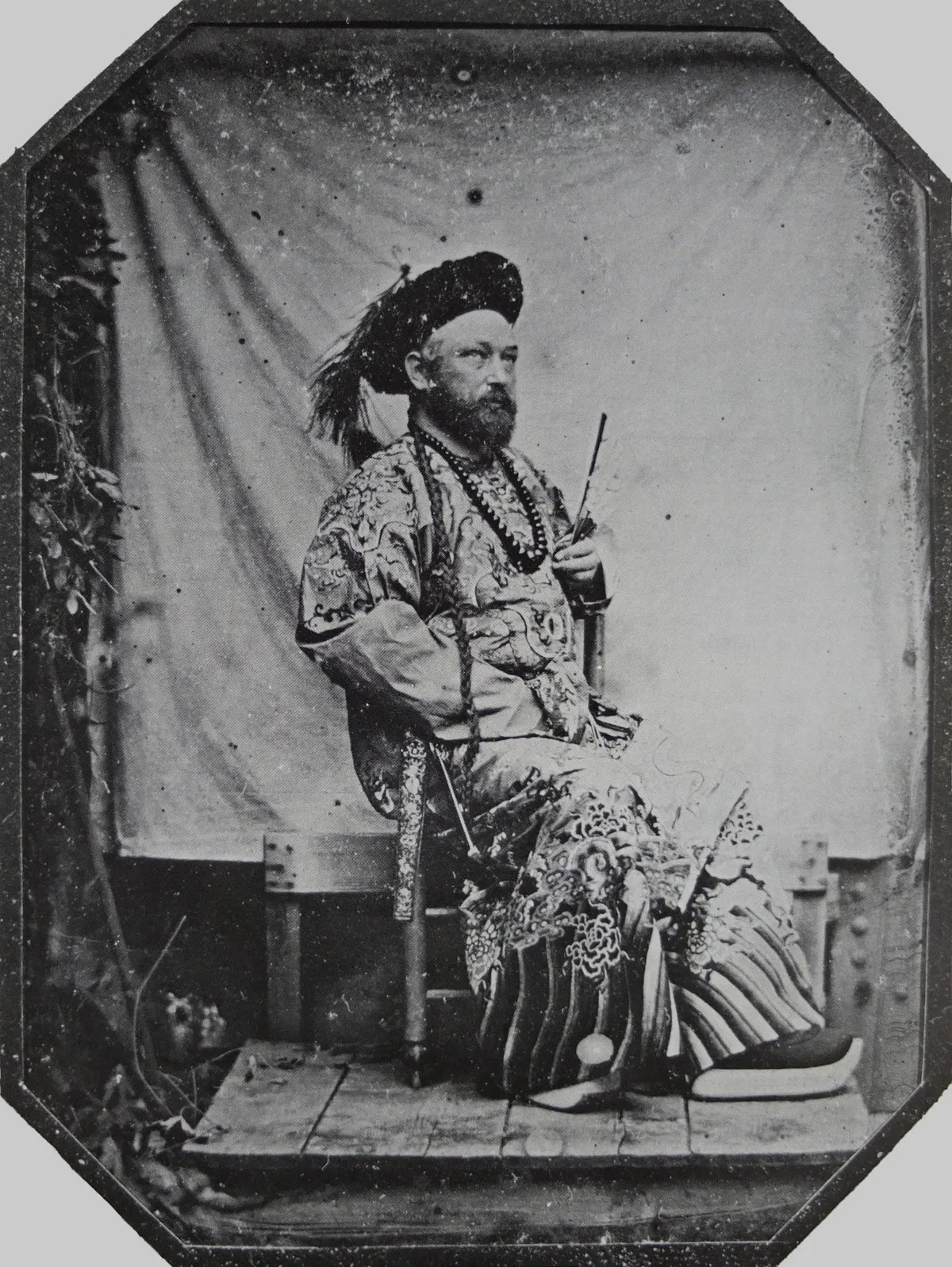
It was in Saint-Louis, Senegal, that Itier noted in his travel logbook a line that has since become a landmark in the history of West African photography: "I received my daguerreotype."1France China Archives (Huma-Num), biographical entry "Jules Alphonse Eugène Itier." fca.huma-num.fr/s/fca/item/55 Art historian Giulia Paoletti (University of Virginia), who has devoted more than a decade to this history — including three years living in Senegal and more than 100 interviews — places in this same period what is today considered the earliest known daguerreotype of West Africa: a view of the port of Saint-Louis showing a few colonial buildings, a square, and two blurred figures straying into the frame — a shot Itier himself described as a "missed shot."4"A new book unearths a buried history of photography in West Africa," CNN Style , 1 March 2024 — on Giulia Paoletti, Portrait and Place: Photography in Senegal, 1840-1960 , Princeton University Press, 2024.
Sources do not fully agree on the exact date of this view — 1842 according to coverage of Paoletti's book, 1843 according to Itier's own logbook — a discrepancy that illustrates how difficult it is to pin down a fine-grained chronology for this period.1France China Archives (Huma-Num), biographical entry "Jules Alphonse Eugène Itier." fca.huma-num.fr/s/fca/item/554"A new book unearths a buried history of photography in West Africa," CNN Style , 1 March 2024 — on Giulia Paoletti, Portrait and Place: Photography in Senegal, 1840-1960 , Princeton University Press, 2024. What is better established is the rest of Itier's journey: by the end of 1843, he had been appointed to head a commercial mission accompanying Théodore de Lagrené's embassy to China, where he would produce one of the very first photographic bodies of work of the country. More than thirty-six plates and over a thousand pages of his travel notebooks are today held at the Musée français de la photographie, in Bièvres.5Musée français de la photographie (Bièvres), Jules Itier holdings — plates and travel notebooks.
Portrait and Place: a history still being written
The fate of this inaugural image sums up, in Paoletti's view, a larger problem: nineteenth-century Senegalese photography went largely ignored by art history for more than a century. "Initially, it wasn't considered an art anywhere — even in the West, it took many decades before we had the first exhibitions at MoMA," she explains. "And since it was not considered an art, it was not collected, studied, and valued as a craft."6Dianna Wray, "Author Giulia Paoletti Traces History of Senegal's Photography," AramcoWorld , November-December 2025. aramcoworld.com Her book Portrait and Place: Photography in Senegal, 1840-1960 (Princeton University Press, 2024) is to date the first in-depth study of this history — from Itier's plate to Senegalese photographers of the 1960s, by way of rediscovered figures such as Mama Casset and Oumar Ka.6Dianna Wray, "Author Giulia Paoletti Traces History of Senegal's Photography," AramcoWorld , November-December 2025. aramcoworld.com
This asymmetry — a French daguerreotype as the documented starting point, a Senegalese history of photography that is written only nearly two centuries later — already announces the question that will run through this whole series: from what point can we speak of a truly African photography, rather than simply a photograph taken in Africa?
Monrovia, 1853: Augustus Washington chooses exile
Thousands of kilometres away, on the coast of Liberia, another story begins — and it has nothing colonial about it. Augustus Washington (born around 1820-1821), the son of an African American father and a mother probably of Asian descent, was in his freshman year at Dartmouth College in the winter of 1843 when he turned to daguerreotype photography to fund his studies.7Jeff Bridgers, "Augustus Washington, Daguerreotypist," Picture This , Library of Congress blog, 27 February 2013. blogs.loc.gov/picturethis He soon left Dartmouth and, within five years, had built a thriving studio in Hartford, Connecticut. By 1850, he was a prosperous photographer and a husband.
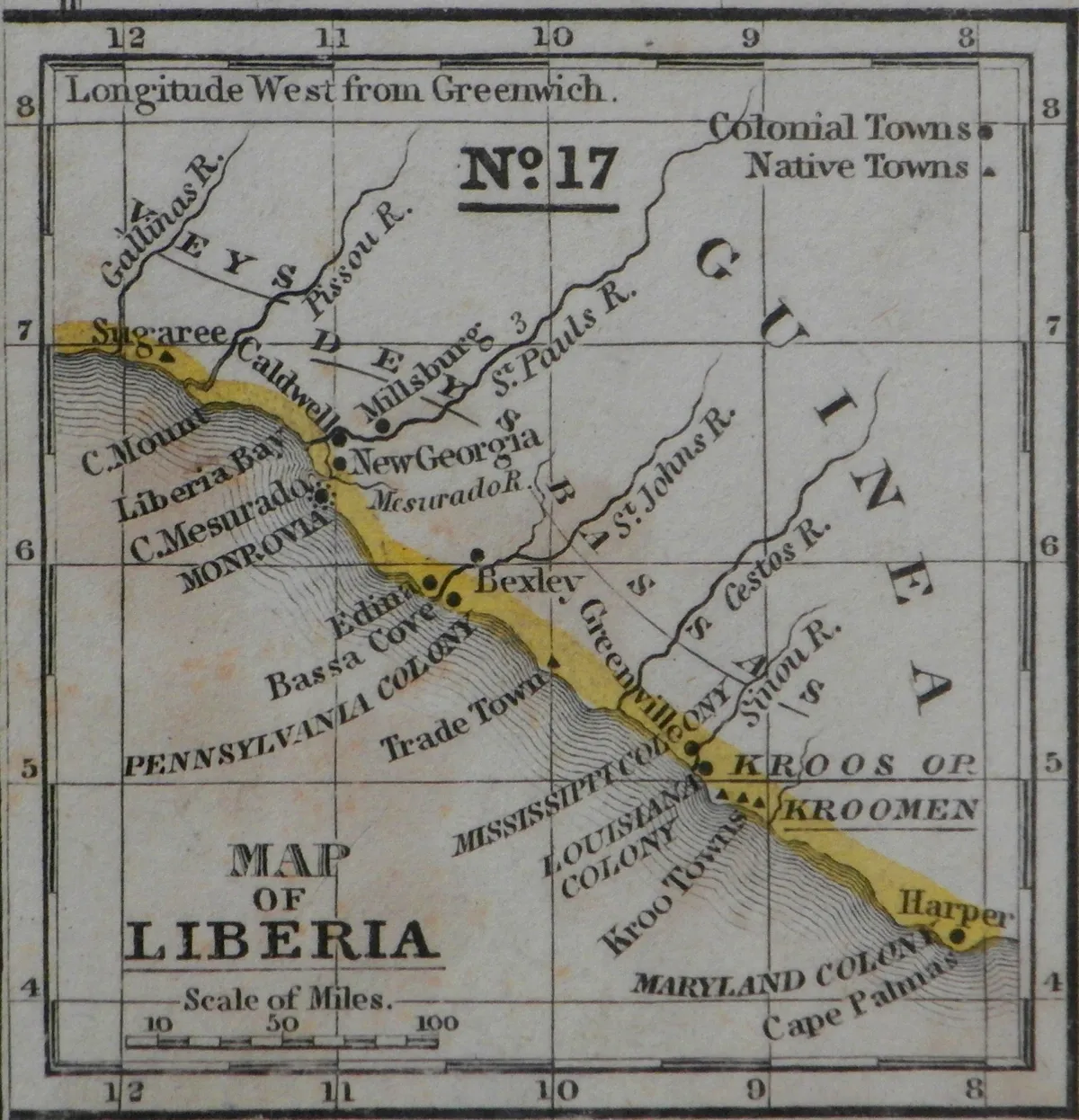
Washington was acutely aware of this. In an 1851 letter to the New York Tribune, he wrote: "Strange as it may appear, whatever may be a colored man's natural capacity and literary attainments, I believe that, as soon as he leaves the academic halls to mingle in the only society he can find in the United States, unless he be a minister or lecturer, he must and will retrograde."7Jeff Bridgers, "Augustus Washington, Daguerreotypist," Picture This , Library of Congress blog, 27 February 2013. blogs.loc.gov/picturethis In the climate of fear that followed the passage of the Fugitive Slave Act, Washington chose emigration over second-class citizenship. In November 1853, with his wife and two young children, he sailed for Monrovia, the capital of Liberia, under the auspices of the American Colonization Society.7Jeff Bridgers, "Augustus Washington, Daguerreotypist," Picture This , Library of Congress blog, 27 February 2013. blogs.loc.gov/picturethis
With money saved in Hartford, Washington set up a daguerreotype studio in Monrovia as soon as he arrived. He quickly became the portraitist of the young republic's political elite — legislators and executive officials — while, between bouts of malaria, turning to trade, real estate, then sugarcane farming, eventually growing a first ten-acre plot into a thousand-acre estate upriver from Monrovia.7Jeff Bridgers, "Augustus Washington, Daguerreotypist," Picture This , Library of Congress blog, 27 February 2013. blogs.loc.gov/picturethis9Carol Johnson, "Faces of Freedom: Portraits from the American Colonization Society Collection," in The Daguerreian Annual, 1996 , Pittsburgh, The Daguerreian Society, 1997, pp. 265-278.
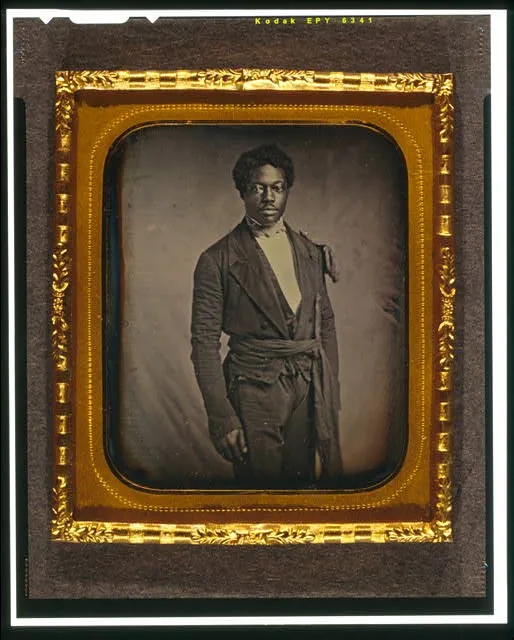
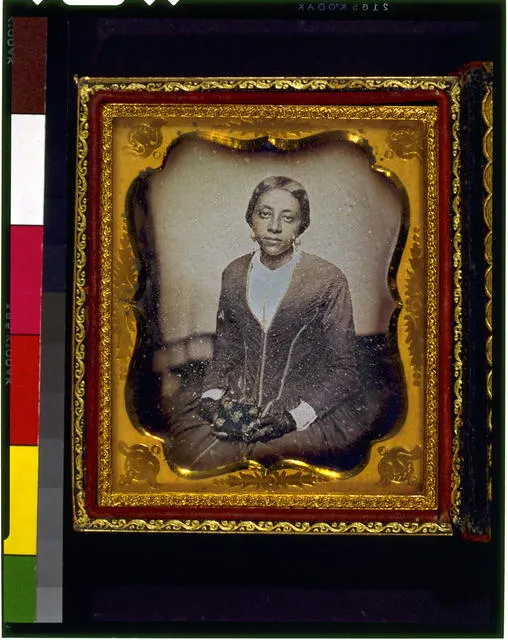
These two plates, held at the Library of Congress, give a sense of Washington's eye. In both, what is striking is how directly the sitters meet the camera, entirely at ease — an unselfconsciousness that historians of African American photography partly attribute to the fact that Washington was photographing his own peers, not subjects he might, like so many European daguerreotypists of the same decade, have treated as mere ethnographic curiosities. The Library of Congress holds, from the same studio, several other figures of the republic — including Stephen Allen Benson, Liberia's second president.10Library of Congress, Prints and Photographs Division, "[Chancy Brown, three-quarter length portrait, facing front]," LC Control Number 2004664297. loc.gov/item/2004664297 — rights advisory: no known restrictions on publication.
Many of his portraits, commissioned by the American Colonization Society itself, were meant to be shown in the United States to make the case for the recolonisation project.9Carol Johnson, "Faces of Freedom: Portraits from the American Colonization Society Collection," in The Daguerreian Annual, 1996 , Pittsburgh, The Daguerreian Society, 1997, pp. 265-278. The last known trace of Washington active behind the camera dates from the late 1850s. He then began a political career: he sat twice in Liberia's House of Representatives — where he was elected speaker — and served one term in the Senate.7Jeff Bridgers, "Augustus Washington, Daguerreotypist," Picture This , Library of Congress blog, 27 February 2013. blogs.loc.gov/picturethis He died in Monrovia in 1875; the African Repository marked his passing by noting that "nothing could induce him to return to this country [America], having acquired a handsome property and freedom and a home in his ancestral land."7Jeff Bridgers, "Augustus Washington, Daguerreotypist," Picture This , Library of Congress blog, 27 February 2013. blogs.loc.gov/picturethis
A tight fifteen-year chronology — Senegal (1842-1843) and Liberia (1853) bracket, in time, the southern Africa of the previous episode (1846-1851). Original infographic made for this article.
Two routes, not yet an African photography
Itier and Washington have, on the surface, nothing in common: one documents a commercial stopover in passing, on behalf of French expansion; the other deliberately builds his life and fortune in West Africa, becomes a citizen there, then a political leader. But neither one is, in the sense used by historians specialising in African photography, an African photographer: Itier remains an official passing through, and Washington, though a Liberian by choice and by law, remains an African American trained in Hartford, practising an imported craft.
That is precisely the distinction historian Jürg Schneider draws when he places the emergence of a photography produced by Africans, for local clienteles only in the second half of the nineteenth century — with figures such as Francis W. Joaque, active in Sierra Leone, Fernando Po, and then Gabon from the 1860s onward.13Jürg Schneider, "The Topography of the Early History of African Photography," History of Photography , vol. 34, no. 2, 2010, pp. 134-146. (already cited in episode 1) Between the Ras el-Tin daguerreotype (1839), the Saint-Louis one (1842-1843), and Washington's studio in Monrovia (1853-late 1850s), some fifteen years passed — and photography, in West Africa as elsewhere on the continent, remained, almost everywhere, a practice imported from elsewhere.
Ultimately, these two 1840s-1850s trajectories trace less a continuity than a contrast: on one side, a colonial administration documenting in passing; on the other, a man who chose West Africa as home and built there, with the same technique, a body of work and a life. It would take another decade, with figures such as Francis W. Joaque, for a photography held by Africans themselves to emerge — the subject of this series' next episode.
A note on method: text drawing on academic and institutional sources (France China Archives/Huma-Num, the J. Paul Getty Museum, the Musée français de la photographie, the Library of Congress, Princeton University Press), a specialist press article (CNN Style), and the Library of Congress's own editorial blog, to the exclusion of any collaborative encyclopaedia as a source of fact — Wikimedia Commons is used here solely as a host for public-domain images, never as a source of historical claims. Images: five period photographs and engravings, each individually verified — both Augustus Washington daguerreotypes were confirmed directly on the Library of Congress's own catalogue pages (marked "no known restrictions on publication," with precise capture dates) rather than taken as given from a secondary source. One illustration lead initially considered for the Saint-Louis plate — a set of engravings from Gallica/BnF — was checked and then dropped: its actual content (ethnographic portraits, not a view of the town) did not match the caption originally planned for it, and its reuse terms are restricted. That section is therefore left without an image rather than published with an inaccurate caption. The two infographics (spread map, timeline) are original illustrations made for this article.
Sources
- France China Archives (Huma-Num), biographical entry "Jules Alphonse Eugène Itier." fca.huma-num.fr/s/fca/item/55 ↩
- Alphonse-Eugène-Jules Itier, artist record, The J. Paul Getty Museum. getty.edu/art/collection/person/103KEW ↩
- "Jules Itier en 1847 déguisé en mandarin à Marseille," self-portrait daguerreotype. Wikimedia Commons, Jules Itier category. commons.wikimedia.org/wiki/Category:Jules_Itier — public domain. ↩
- "A new book unearths a buried history of photography in West Africa," CNN Style, 1 March 2024 — on Giulia Paoletti, Portrait and Place: Photography in Senegal, 1840-1960, Princeton University Press, 2024. ↩
- Musée français de la photographie (Bièvres), Jules Itier holdings — plates and travel notebooks. ↩
- Dianna Wray, "Author Giulia Paoletti Traces History of Senegal's Photography," AramcoWorld, November-December 2025. aramcoworld.com ↩
- Jeff Bridgers, "Augustus Washington, Daguerreotypist," Picture This, Library of Congress blog, 27 February 2013. blogs.loc.gov/picturethis ↩
- S. Augustus Mitchell, Map of Liberia colony, from Mitchell's School Atlas, 1839. Wikimedia Commons. commons.wikimedia.org/wiki/File:Mitchell_Map_Liberia_colony_1839.jpg — public domain. ↩
- Carol Johnson, "Faces of Freedom: Portraits from the American Colonization Society Collection," in The Daguerreian Annual, 1996, Pittsburgh, The Daguerreian Society, 1997, pp. 265-278. ↩
- Library of Congress, Prints and Photographs Division, "[Chancy Brown, three-quarter length portrait, facing front]," LC Control Number 2004664297. loc.gov/item/2004664297 — rights advisory: no known restrictions on publication. ↩
- Library of Congress, Prints and Photographs Division, "[Woman, probably Sarah McGill Russwurm, sister of Urias Africanus McGill...]," LC Control Number 2004664344. loc.gov/item/2004664344 — rights advisory: no known restrictions on publication. ↩
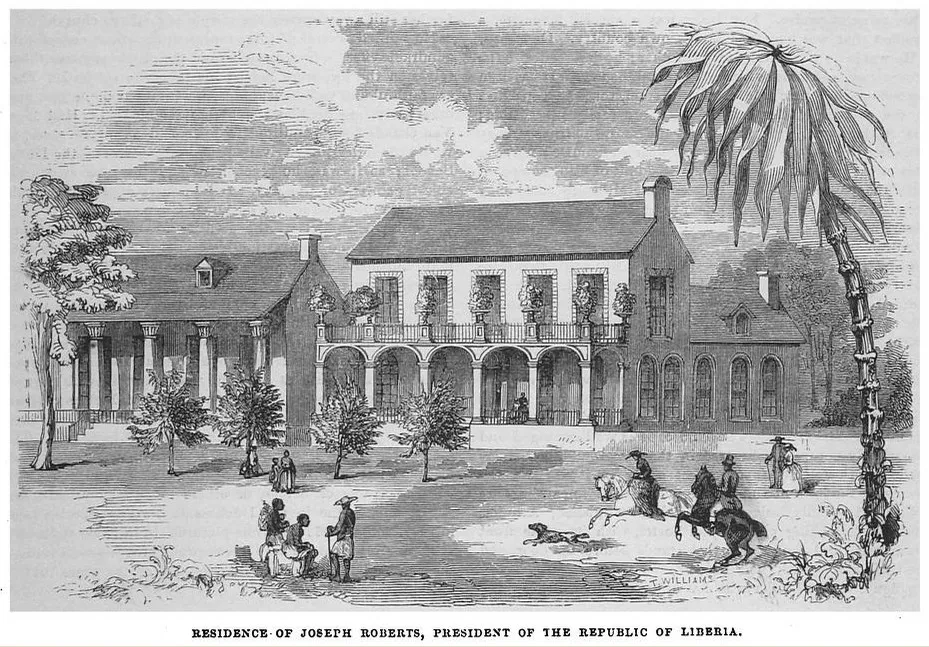
- T. Williams, Residence of Joseph Roberts, President of the Republic of Liberia, engraving, c. 1850. Wikimedia Commons. commons.wikimedia.org/wiki/File:T.WILLIAMS(c1850)_Residence_of_Joseph_Roberts,_President_of_the_Republic_of_Liberia.jpg — public domain. ↩
- Jürg Schneider, "The Topography of the Early History of African Photography," History of Photography, vol. 34, no. 2, 2010, pp. 134-146. (already cited in episode 1) ↩

_Residence_of_Joseph_Roberts,_President_of_the_Republic_of_Liberia.jpg)
Further reading
- Giulia Paoletti, Portrait and Place: Photography in Senegal, 1840-1960, Princeton University Press, 2024.
- Ann M. Shumard, A Durable Memento: Portraits by Augustus Washington, African American Daguerreotypist, Smithsonian NPG, 1999.
- Deborah Willis, Reflections in Black: A History of Black Photographers 1840 to the Present, W.W. Norton, 2000, pp. 3-10.
- Jürg Schneider, "The Topography of the Early History of African Photography," History of Photography, vol. 34, no. 2, 2010, pp. 134-146.
Comments
Be the first to comment